


 Krit Ariyathiti
Meditation music is calm, slow and usually instrumental sound that you play while you meditate, breathe or wind down. It gives the mind something gentle to rest on, and it can mask background noise. This guide explains the main styles, what research does and does not show, how to choose a track, and how creators can publish their own meditation music responsibly. Also, it looks at binaural beats, singing bowl music and mindfulness music.
Quick answer: Choose music without lyrics, a slow or steady pulse and a soft sound such as ambient pads, piano, flute or singing bowls. Keep the volume low, start with 5 to 10 minutes, and treat silence as a perfectly good option. Research suggests that mindfulness practice may help with anxiety and that listening to music may ease anxiety in some settings, but the evidence is modest and mixed. As a result, meditation music is best seen as a comfort tool, not a medical treatment.
What is meditation music?
Meditation music is background audio designed to support a quiet, focused state. It is not one genre. Instead, it borrows from several: ambient, new age, classical, world instruments and sound design. What they share is a lack of sudden changes. For instance, there are usually no sharp drums, no dramatic builds and no lyrics that pull your attention into a story.
Many people use meditation music for four purposes:
- Seated meditation or breathing practice, where the music sets a steady mood.
- Body scans and relaxation, where slow sound helps the body settle.
- Yoga and stretching, where a gentle pulse can guide the pace.
- Winding down before bed, where softer and slower tracks are popular.
What types of meditation music exist?
Here are the styles you will meet most often, with the kind of moment each suits:
| Style | What it sounds like | Often used for |
|---|---|---|
| Ambient pads | Long, slowly shifting synthesiser tones | Seated meditation, deep focus |
| Singing bowl music | Sustained metallic tones that fade slowly | Breath practice, ending a session |
| Piano or flute | Sparse, soft notes with plenty of space | Mindfulness, journaling, relaxing |
| Nature sound mixes | Rain, water or forest sounds, with or without music | Masking noise, sleep |
| Binaural beats | Two slightly different tones in each ear, played on headphones | Experiments with relaxation |
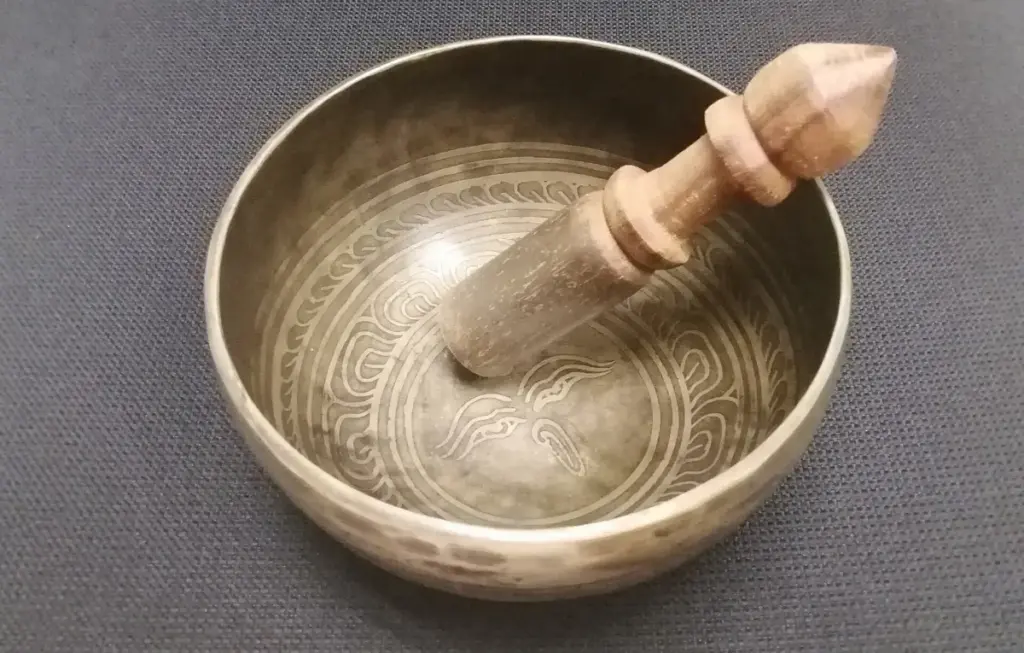
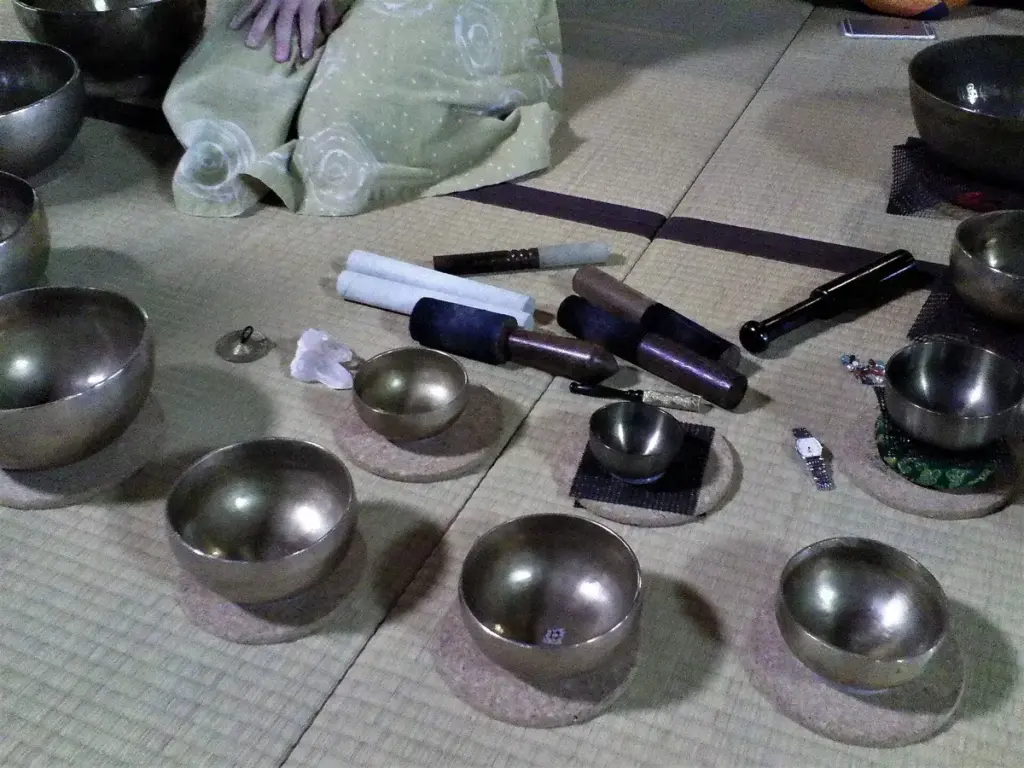
Singing bowls, for example, are a traditional instrument in some Himalayan and East Asian practices, and many modern tracks recreate their long, glowing tones. You do not need to use any of these. A silent room with a timer works well for many people, and some practices deliberately avoid sound.
Why is singing bowl music so popular?
Singing bowl music uses sustained tones that rise and fade slowly, so there is no beat to follow. As a result, the sound gives a clear start and end to a session, which is why teachers often use a bowl as a timer. Recorded versions are easy to loop, and they work well at very low volume. The sound can feel harsh to some listeners, though, so test it on your own speakers first.
What does research say about meditation music?
It helps to separate three questions, because they have different answers.
Does meditation itself help?
According to the US National Center for Complementary and Integrative Health, whose evidence summary was updated in June 2022, mindfulness approaches have been found to work better than no treatment for anxiety and depression and about as well as some evidence-based therapies. However, the same page notes that confidence is limited, results for pain and sleep are mixed or modest, and long-term effects were not found in studies that followed people longer than two months.
Does listening to music help?
A series of Cochrane reviews has looked at music listening in medical settings. For example, the Cochrane review on preoperative anxiety pooled 26 trials and concluded that music listening may have a beneficial effect, while rating much of the evidence as low quality. Those results come from patients waiting for procedures, so they do not prove the same effect for everyday meditation.
Do binaural beats help?
Some systematic reviews report lower anxiety, often in people before medical procedures, but the studies are small and varied. A 2024 review of randomised trials in non-clinical settings did not find the evidence strong enough for a wide recommendation, and noted that little is known about side effects or the best protocol. In short, they are safe to try for most people, yet nobody can promise a result. So treat them as an experiment.
As of November 2026, this is general information, not medical advice. If you have anxiety, sleep problems, a history of trauma or any health condition, talk to a qualified professional first.
Is meditation always relaxing?
Not always, and it is wise to know that. The NCCIH page above reports that, in a review of 83 studies, about 8% of participants had a negative effect, most often anxiety or depression, a rate similar to that of psychological therapies. In other words, if a practice makes you feel worse, you are allowed to stop. Also, music can add comfort for some people and distraction for others.
Also remember that meditation should not replace standard medical care or delay seeing a health professional about a medical problem.
How do you choose mindfulness music that suits you?
Use this short checklist:
- Pick instrumental tracks. Words invite your mind to follow the story.
- Look for a slow, steady pulse, or no pulse at all.
- Avoid sudden changes in volume, pitch or instruments, because they can pull you out of the practice.
- Match the length to your session. A 10 minute practice needs a track or playlist that fades gently, not an ad break.
- Keep the volume low. The music should sit beneath your breathing, not above it.
- Test it once, then stop searching. Switching tracks constantly is its own distraction.
Furthermore, consider where you will play your meditation music. Speakers suit group or open-room sessions, while headphones help in noisy spaces. If you use headphones for binaural beats, they must be worn as the track describes, and a low volume is safer for your ears.
How do you build a routine with mindfulness music?
You do not need an hour. A short routine like this works for many beginners, because it is easy to repeat:
- Choose a quiet spot and sit or lie down comfortably.
- Start the music at a low volume and set a timer for five to ten minutes.
- Follow your breath. When you notice your mind has wandered, gently return to the breath.
- Let the music fade and sit in silence for a minute before you stand up.
- Repeat daily at the same time, because a habit is easier to keep than a mood.
After a week, try the same session without music, then compare. Neither version is better by default. Instead, choose what you will actually keep doing.
Guided meditation or music: which is better?
A guided meditation uses a spoken voice to lead you through the practice, while music gives a mood and leaves the steps to you. Beginners often like guided sessions because they say what to do next. Still, experienced practitioners often prefer music or silence. You can also combine them, for example a guided track over very soft ambient sound, as long as the voice stays clear and the music stays quiet.
What should creators know before publishing meditation music?
Meditation and relaxation audio is a popular category on streaming sites and YouTube, so creators and brands often make their own. Therefore, if you plan to publish, keep these points in mind:
- Be clear about rights. Use music you made, or music licensed for your use. Our guide to royalty-free music for YouTube explains licences in plain language.
- Check the terms of any AI tool. If you generate tracks with software, read the plan terms and the rules around ownership, as covered in our guide to AI music generators.
- Avoid health promises. Do not claim that your music cures, treats or prevents any condition. Describe the mood and the use, such as "calm instrumental music for breathing practice".
- Offer variety and honesty. Titles, descriptions and thumbnails should match what the listener hears.
Music from Develop Marketing
Develop Marketing creates original AI-generated instrumental music and publishes it on its own YouTube channels. If you want something slower and softer for the end of the day, try our deep sleep music. For a steadier mood while you work or study, see our guide to ambient music for focus.
Need help with music for your brand?
Develop Marketing helps businesses with social media, AI content, SEO, AEO and GEO, WordPress websites and advertising, and we also create original AI instrumental music for content and ads. See our services page (in Thai) or contact us.
Frequently asked questions
No. Many people meditate in silence or with natural sounds. Meditation music is simply one option that some people find comfortable.
Instrumental music is usually easier, because lyrics ask your brain to process language. Some people use mantras or chants, which is a different practice with its own purpose.
The research is promising in some settings but limited and mixed overall. They are low risk for most people, but they are not a proven treatment. Stop if you feel uncomfortable.
Five to ten minutes is a good start. You can extend the time as the habit grows, but longer is not always better.
Only if you own the music or hold a licence that covers your use. Read the licence or plan terms, keep proof of them, and avoid making health claims.
Final thoughts
Meditation music is a simple tool for creating a calm space. Choose slow, instrumental tracks, keep the volume gentle, and use it as a cue for a short daily habit. Research on mindfulness and on music listening is encouraging but modest, so treat meditation music as comfort, not as treatment. If you create your own, be clear about rights and honest in how you describe it.