


 Krit Ariyathiti

Good expat health insurance Thailand cover is what turns a hospital stay from a financial shock into a manageable bill. This guide explains how health insurance for retirees in Thailand works, what private hospitals in Thailand typically charge, who can use Thai social security for foreigners, and what the O-A visa insurance rule asks for, with a quiet stay idea in Krabi at the end.
Quick answer: As of November 2026, most expats in Thailand rely on private health insurance, because Thailand's public schemes mainly cover Thai citizens and foreigners employed with a work permit. Some long-stay visas require cover: for example, the O-A retirement visa asks for at least 3,000,000 baht (or USD 100,000) of health insurance for the stay. Private hospitals are well equipped, but serious treatment can cost hundreds of thousands of baht. Compare policies by limits, exclusions, age rules and pre-existing conditions, not by price alone. This is general information, not financial or medical advice.
Expat health insurance Thailand: your main options
| Option | Who it suits | What to know |
|---|---|---|
| Thai local health policy | Long-stay residents, visa applicants | Often cheaper; check age limits and the visa certificate |
| International health policy | Frequent travellers, families | Wider cover and choice; usually more expensive |
| Travel insurance | Short trips | Not designed for long stays or ongoing care |
| Social security (Section 33) | Foreigners employed in Thailand | Linked to one registered hospital |
In general, expat health insurance Thailand plans differ most in three areas: the annual limit, outpatient cover and pre-existing conditions. Therefore, read the policy wording, not just the summary.
Health insurance for retirees in Thailand
Health insurance for retirees in Thailand is the area where age matters most. Many insurers set maximum entry ages, and premiums rise as you get older. Furthermore, pre-existing conditions are often excluded or covered only after a waiting period.

When you compare expat health insurance Thailand plans, check:
- Entry age and renewal age, so the policy can continue as you age.
- Inpatient and outpatient limits, because both matter for visa rules and daily care.
- Pre-existing conditions, including waiting periods and exclusions.
- Direct billing with the hospitals near your home.
- Deductibles and co-payments, which lower the premium but raise your share of each bill.
Our retire in Thailand guide explains the retirement visa routes that link to these rules.
O-A visa insurance: what the rule asks for
The O-A visa insurance requirement is the best-known rule. According to insurer guidance and embassy information, O-A applicants need health insurance covering at least 3,000,000 baht, or USD 100,000, for the whole stay. Some insurer pages tie this to Ministry of Public Health rules from 2021, with renewals needing the higher amount from 2022.
The O-X 10-year visa has its own insurance rule, which guides describe as at least 40,000 baht outpatient and 400,000 baht inpatient cover. Similarly, the Long-Term Resident visa accepts either insurance of about USD 50,000, social security that covers Thailand, or a large deposit, according to recent guides. Because these thresholds change, check the embassy and the official e-Visa site before you buy a policy.
Private hospitals in Thailand: what to expect
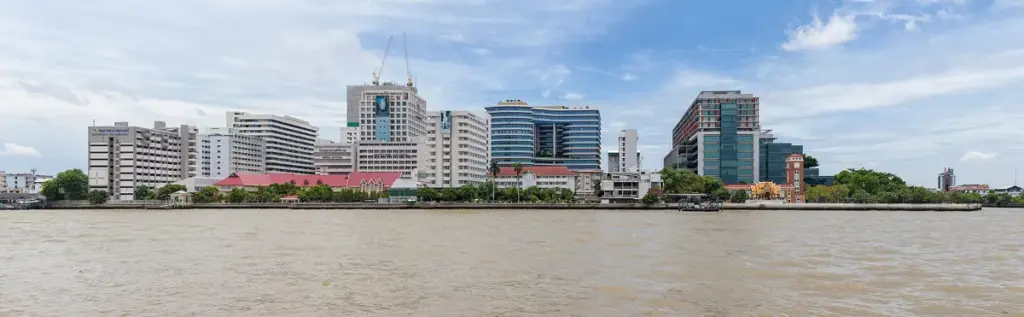
Private hospitals in Thailand are a major reason expats feel safe living here. Big-city hospitals usually have English-speaking staff, short waits and modern equipment. However, prices vary a lot between hospitals and cities.
As of November 2026, recent guides give these rough ranges:
- A doctor visit: about 800 to 3,000 baht at a private hospital, depending on the hospital.
- Intensive care: guides cite about 80,000 to 150,000 baht per day at top private hospitals.
- Major surgery: can run into hundreds of thousands, or over a million baht.
These are examples from guides, not quotes. So, ask the hospital for an estimate before planned treatment. Public hospitals are much cheaper but busier, and English may be limited outside large cities. Our Thailand travel insurance guide also explains what tourists should check.
Thai social security for foreigners
Thai social security for foreigners is mainly for people with a Thai employer and a valid work permit. According to recent guides, employees under Section 33 pay 5% of wages up to a ceiling of 17,500 baht a month, so the maximum is 875 baht a month from January 2026. In return, they receive care at one registered hospital.
However, retirees, digital nomads without a Thai employer and many self-employed people are not covered. As a result, most of them need private health insurance. Even employees often add a private plan, because social security limits you to the registered hospital for most care.
How to choose a policy in five steps
Choosing expat health insurance Thailand cover is easier in steps:
- List your needs. Visa rules, age, health history and family members.
- Set your budget. Decide on deductibles and co-payments you can afford.
- Compare wording. Check limits, exclusions and waiting periods side by side.
- Check hospitals. Confirm direct billing near where you live.
- Keep proof. Store the policy and visa insurance certificate safely.
Also, review your expat health insurance Thailand cover every year, because rules and premiums change. This is general information, not financial advice, so speak to a licensed adviser if you are unsure.
Frequently asked questions
It is not required for every visa, but it is strongly recommended. Some visas, such as the O-A retirement visa, require it. Private hospital bills for serious care can be very high.
According to insurer and embassy guidance, at least 3,000,000 baht, or USD 100,000, for the stay. Check the latest rule with your embassy before you apply.
Foreigners can pay to use public hospitals. However, the social security scheme mainly covers foreigners employed in Thailand with a work permit, and most retirees are not covered.
Usually not. Travel insurance is built for short trips. For long stays, look at local or international health insurance instead.
Often not, or only after a waiting period. Read the policy wording carefully and declare your health history honestly.
Expat health insurance Thailand sorted, then rest near Krabi
At a glance: 17 houses from 1,200 to 2,000 baht per night, air conditioning in every house, free breakfast, free Wi-Fi and a swimming pool, at 97/1 Moo 1, Ao Luek Nuea, Krabi.
With cover in place, a calm stay is easier to enjoy. Fly to Krabi, and from Krabi airport, Ao Luek is about 54 to 71 minutes by road, according to transfer listings. Our Krabi airport to Ao Luek guide explains the transfer.
There, we recommend Ban Kamnan Resort in Ao Luek Nuea. For a couple travelling with a child, House #4 and #9 each have one 5 ft bed and one 3.5 ft bed, one bathroom and 32 m², and sleep three for 1,350 baht per night. Like every house, they have air conditioning. Also, guests share the swimming pool, and breakfast of toast, fried eggs and hot coffee is free. Prices match the resort's listing, so check your dates on Booking.com. Our where to stay in Krabi guide lists other areas.
Final thoughts
The right expat health insurance Thailand plan depends on your visa, age and health. First, check what your visa requires. Next, compare policies by limits, exclusions and hospital networks. Then, review your cover every year. In short, good insurance lets you enjoy Thailand's excellent private hospitals without fearing the bill.








