


 Krit Ariyathiti
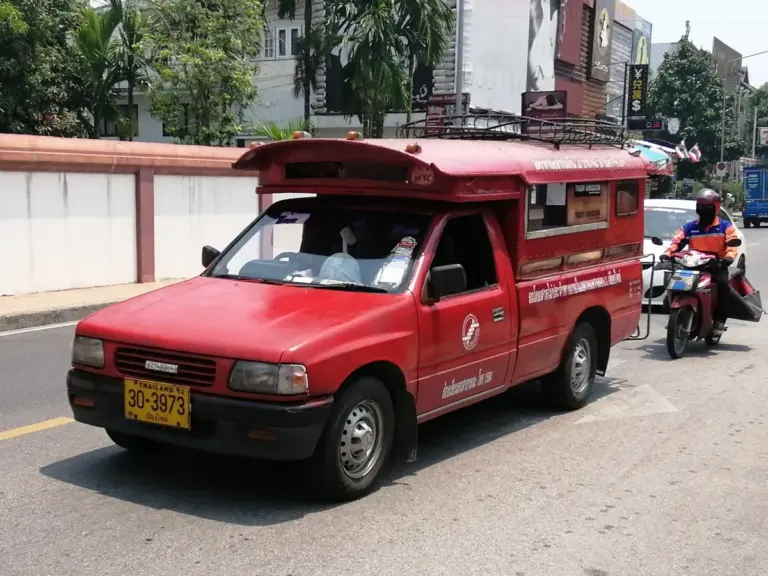
A songthaew in Thailand is a pickup truck with two benches in the back that works as a local bus or shared taxi. You see one in almost every town. Examples are the red songthaew of Chiang Mai, the blue trucks of Phuket and the baht bus Pattaya loop. This guide explains how the system works and what a songthaew fare usually costs. It also shows how to hail, ride and pay, and it covers songthaew vs Grab for short trips. If you already use Grab in Thailand, think of the songthaew as the low-tech partner for short hops.
Quick answer: The word songthaew means "two rows", after the two bench seats, according to Wikipedia. Some trucks follow a fixed route, and some share a ride with passengers going the same way. Others are chartered for one group. As of November 2026, guides put a shared ride in Chiang Mai at about 30 to 40 baht per person. They put a Pattaya baht bus ride at about 10 baht on central routes. So, a songthaew in Thailand is cheap, but the price depends on the type of ride. Agree the price before you board if the truck is not on a fixed route, and pay the driver when you get off.
What is a songthaew in Thailand?
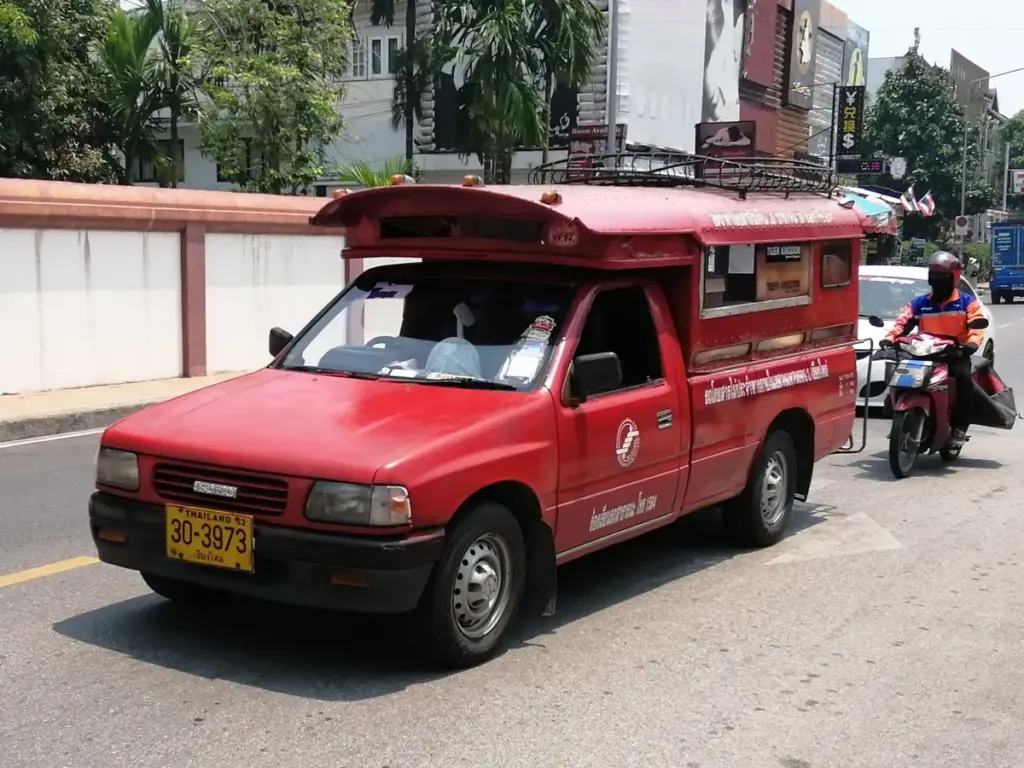
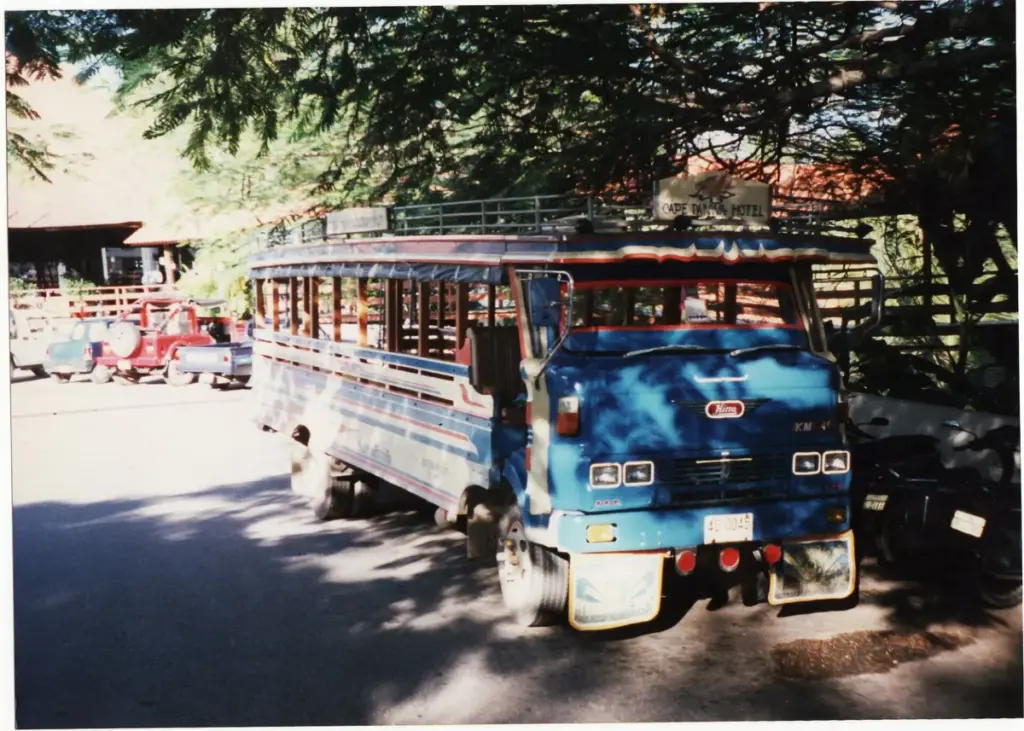
The Thai word สองแถว means "two rows". According to Wikipedia, the name comes from the two bench seats fixed along the sides of the truck bed. Also, a roof covers the back, and curtains or plastic sheets may keep out the rain. Town trucks are usually adapted pickups. In contrast, longer routes use bigger truck bodies that seat about 40 people.
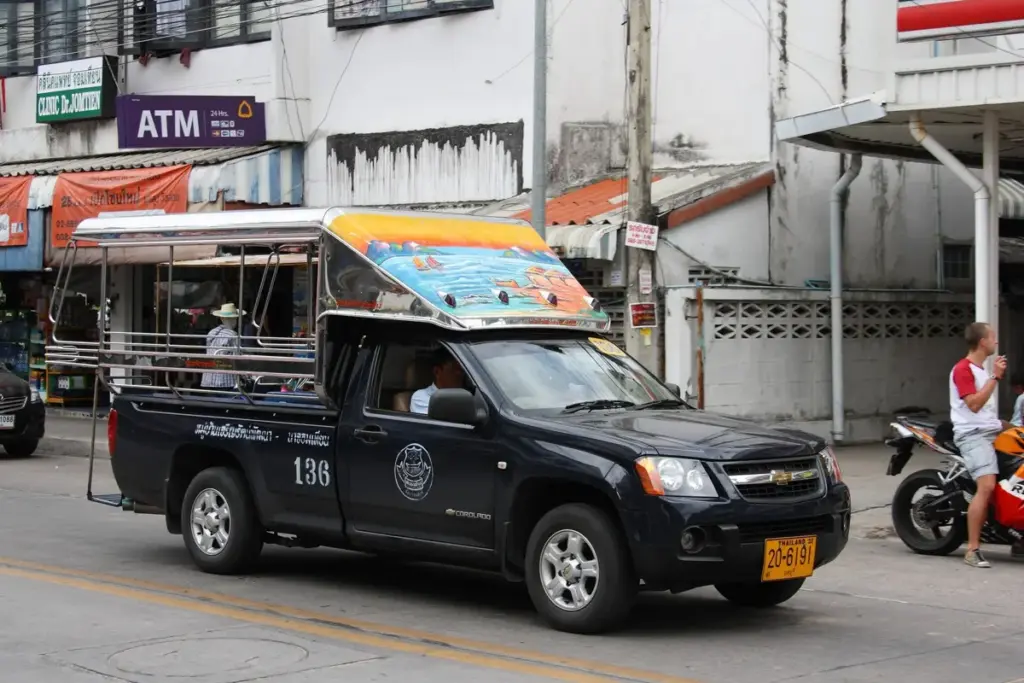
Wikipedia dates the first songthaews to the 1950s, when they were based on small sedans. Since then they have spread to towns across the country. As a result, the same word covers vehicles that look quite different, so a songthaew in Thailand can be red, blue, white or black.
Fixed route, shared ride or charter?
Guides describe three ways a songthaew works. Then the type decides how you pay.
- Fixed route. The truck runs a set road, much like a city bus. It shows its destinations on the roof box or side panels. Pattaya's beach loop and Phuket's beach routes work this way, according to Thailand Guide.
- Shared ride. The driver takes people heading in the same general direction and drops them in turn. In Chiang Mai, for example, the truck may decline a stop that is far from its zone, or quote a higher price.
- Charter. Instead, you hire the whole truck for your group. Agree the price before you get in.
On a fixed loop, one guide advises not to ask the fare before boarding, because that can prompt a charter price. On a shared or charter ride, the opposite is true, so ask first.
The red songthaew in Chiang Mai
The red songthaew is a familiar sight in Chiang Mai. People in Chiang Mai call it rot daeng, which means "red car". Wikipedia says red is the most common colour there. According to a 2026 Chiang Mai guide, the red songthaew driver waves you aboard if your stop fits the route. Otherwise, the driver offers a direct ride at a higher price.
Many travellers meet it first on a short city hop. For example, our things to do in Chiang Mai guide mentions red trucks around the moat and across town. Also, our Chiang Mai on a budget guide uses the same 30 to 40 baht shared fare for a red songthaew.
Baht bus Pattaya: the fixed loop
The baht bus Pattaya trucks run along Beach Road and Second Road, according to Thailand Guide. Our Pattaya on a budget guide puts the fare at about 10 baht on central routes and about 20 baht on longer runs such as Jomtien or Naklua, paid when you get off. Because the route is a loop, you tell the driver your destination only if you go beyond it.
Songthaew fare: what guides report
A songthaew fare depends on the town, the distance and the type of ride. The table shows figures from the guides we read. So, treat each songthaew fare as a rough guide, not a price list.
| Place | Ride | Reported fare |
|---|---|---|
| Chiang Mai | Shared ride in town | About 30 to 40 baht per person |
| Chiang Mai | Late-night direct ride | About 60 to 100 baht, one guide says |
| Pattaya | Baht bus, central route | About 10 baht |
| Phuket | Phuket Town to Patong | About 40 to 50 baht, according to Thailand Guide |
| Koh Samui | Typical ride | About 50 to 100 baht |
| Koh Chang | Ao Thammachat ferry to Bang Bao | About 150 to 200 baht, as quoted |
| Krabi | Krabi Town to Ao Nang | About 50 to 60 baht in several guides, but sources are old |
Chartered rides cost more. Thailand Guide gives about 150 to 300 baht for a private ride in town and about 1,200 to 2,000 baht for a full-day charter, while a Chiang Mai guide lists 100 to 200 baht for a short charter. Prices vary, so ask first when you are unsure. In addition, our Koh Samui on a budget guide has more on island rides.
How to hail, ride and pay
Using a songthaew in Thailand takes a few simple steps, and the first is to hail the truck.
- Hail the truck. Hold your arm out with the palm facing down toward the road. Do not wave high in the air.
- Check the route. On a loop, read the sign. Then, on a shared ride, name your stop and ask the price.
- Climb in and hold on. There are usually no seatbelts, so grip the rails on bends.
- Signal your stop. Tap the roof or press the buzzer on the ceiling, about 50 metres before you want to stop, according to guides.
- Pay in cash. Hand over the fare when you get off, and carry 10 and 20 baht notes.
Drivers do not announce stops, so keep an eye on a map app. In the rain, curtains may not cover the open sides, so a light jacket helps.
Songthaew vs Grab: which is easier?
Songthaew vs Grab is a question of distance, time and luggage. A 2026 Chiang Mai guide says Grab suits cross-town trips, after dark and trips with luggage, because the fare shows on the app. In contrast, a songthaew works well for short, well-known routes where the shared fare is low. So, songthaew vs Grab rarely has one winner.
| Question | Songthaew | Grab |
|---|---|---|
| Short hop on a known route | Usually fine | Works too |
| After dark | Fewer trucks, charter more likely | Easier to find |
| Large suitcase or limited mobility | Poor fit, according to one guide | Better |
| Price known in advance | Only on a fixed route | Yes, on the app |
| Rain | Sides may be open | Dry car |
Because services differ by town, our Grab in Thailand guide explains the ride-hailing rules. Meanwhile, our Thailand travel costs guide shows how rides add up.
Songthaews in Krabi and Ao Luek
A songthaew in Thailand also serves Krabi. One guide describes a white songthaew between Krabi Town and Ao Nang at about 50 to 60 baht. It adds that fewer trucks run after about 18:00. Sources there are old, so ask locally. We found no published songthaew timetable for Ao Luek, so do not count on one. Instead, ask your accommodation, book a car or use a ride-hailing app. Our Krabi airport to Ao Luek guide covers the transfer from the airport.
Safety and etiquette on a songthaew in Thailand
- Agree the price first on shared and charter rides, and pay the agreed amount.
- Hold the rails. Roads can be steep and bumpy on mountain routes, so sit firmly.
- Keep bags on your lap or by your feet, and watch the roof edge.
- Plan for early finishes. For example, one guide says island routes often stop about 18:00.
- Mind your luggage. Large suitcases and buggies fit poorly, so use a car for airport and station runs.
Where to stay: continue south to Krabi
After a trip across several towns, you can fly south to Krabi for a quieter base. From Krabi airport, Ao Luek is about 54 to 71 minutes by road, depending on traffic. Our where to stay in Ao Luek guide covers the area.
At a glance: 17 houses from 1,200 to 2,000 baht per night, air conditioning in every house, free breakfast, free Wi-Fi and a swimming pool, at 97/1 Moo 1, Ao Luek Nuea, Krabi.
We recommend Ban Kamnan Resort in Ao Luek Nuea. For a small group, House #4 and #9 each have one 5 ft bed and one 3.5 ft bed, one bathroom and 32 m². They sleep three for 1,350 baht per night. Like every house, they have air conditioning. Also, guests share the swimming pool, and breakfast of toast, fried eggs and hot coffee is free. Prices match the resort's listing, so check your dates on Booking.com.
Frequently asked questions
It is a pickup truck with two benches in the back that serves as a local bus or shared taxi. The name means "two rows", after the two benches.
A songthaew fare varies by town. Guides put a shared Chiang Mai ride at about 30 to 40 baht. They put a Pattaya baht bus at about 10 baht. Ask the price first when the truck is not on a fixed route.
Tap the roof or press the buzzer on the ceiling a little before your stop. Drivers do not announce stops.
Neither is always better in the songthaew vs Grab choice. A songthaew has a low fare on short known routes. However, Grab shows the price in advance and suits luggage and late nights.
Fewer run after dark. Also, island routes often stop around 18:00, according to one guide. So, plan a ride-hailing app or a charter for late trips.
Final thoughts
A songthaew in Thailand is a simple, low-cost way to move around a town once you know the three types. To sum up: look at the sign and agree the price when the ride is shared. Then pay at the end and keep an app for late nights. When you want a calm base on the Andaman coast, check availability at Ban Kamnan Resort on Booking.com and plan your Krabi leg.
Fares and routes change by town and season, so treat the figures as rough guides and confirm them locally. Sources: Wikipedia, Thailand Guide, a 2026 Chiang Mai songthaew guide, Pattaya Pointer, Koh Samui Pointer.








