

 Krit Ariyathiti
This Thai street food guide explains how to eat well and safely from carts, markets and shophouse stalls anywhere in Thailand. It covers how to order street food in Thailand without speaking Thai, the Thai street food dishes worth trying first, current Thai street food prices, and the honest answer to is street food safe in Thailand, with tips for Bangkok, the north and the southern beaches.
Quick answer: Thai street food is cheap, fast and usually safe if you pick busy stalls that cook food fresh in front of you. Several 2026 guides put a typical street dish, such as pad thai or som tam, at roughly 40 to 80 baht, with higher prices in tourist areas. To order, point at the dish or at another customer's plate, say how spicy you want it, and pay in small notes when you finish or when you collect.
What counts as street food in Thailand?
Street food in Thailand is more than carts on the pavement. It also includes market stalls, night markets, food courts and tiny shophouse kitchens with plastic stools. In short, it is everyday food for local people, cooked quickly and sold at low prices. This Thai street food guide focuses on that everyday food.
In addition, each region has its own style. For example, the north is known for curry noodle soups, the northeast for som tam and grilled chicken, and the south for sour curries and seafood. As a result, the same trip can feel like several food trips. Our guide to southern Thai food covers the dishes of the south.
Thai street food dishes to try first
Start with dishes that are easy to find and easy to like. Then, branch out as you get used to the heat.
- Pad thai. Stir-fried rice noodles with egg, tofu or shrimp, peanuts and lime, so it is a safe first choice.
- Som tam. Green papaya salad pounded with chilli, lime, fish sauce and peanuts.
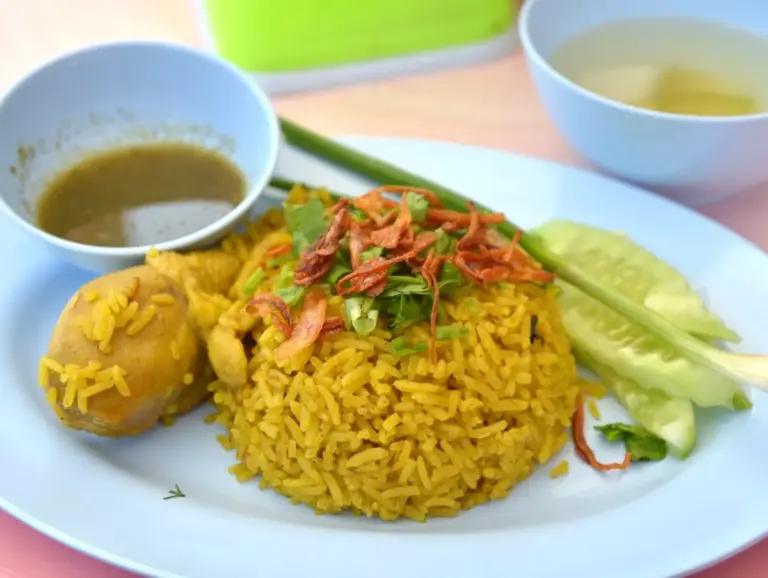
- Khao man gai. Poached chicken on rice cooked in chicken stock, especially good for lunch.
- Pad kra pao. Minced meat fried with holy basil and chilli, often topped with a fried egg.
- Noodle soup. First choose the noodle, then the meat and the broth.
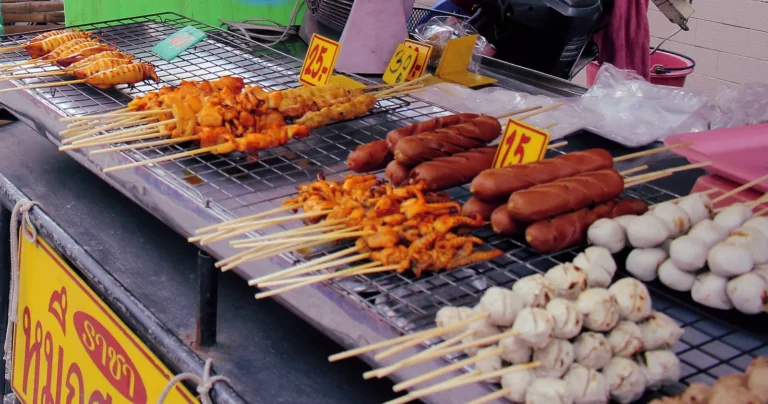
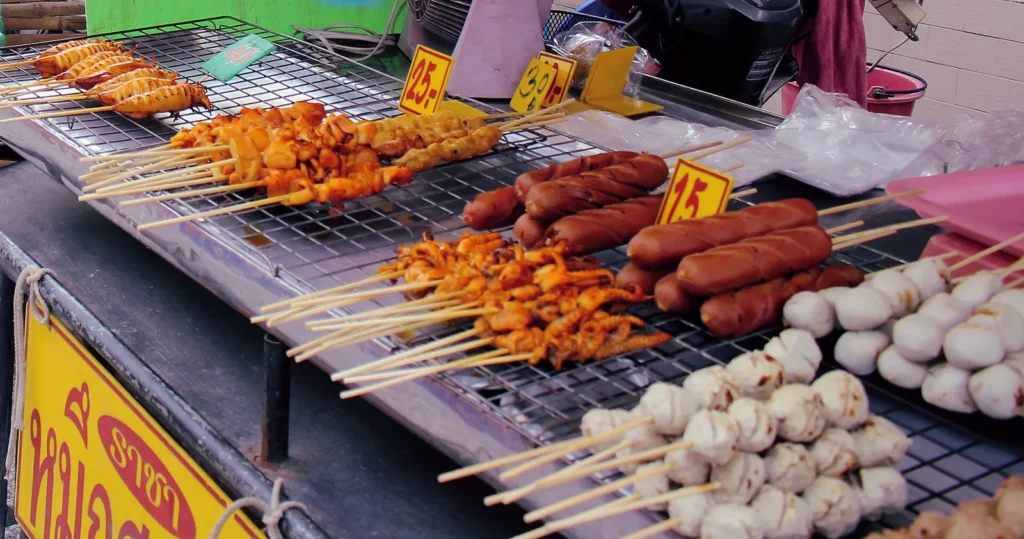
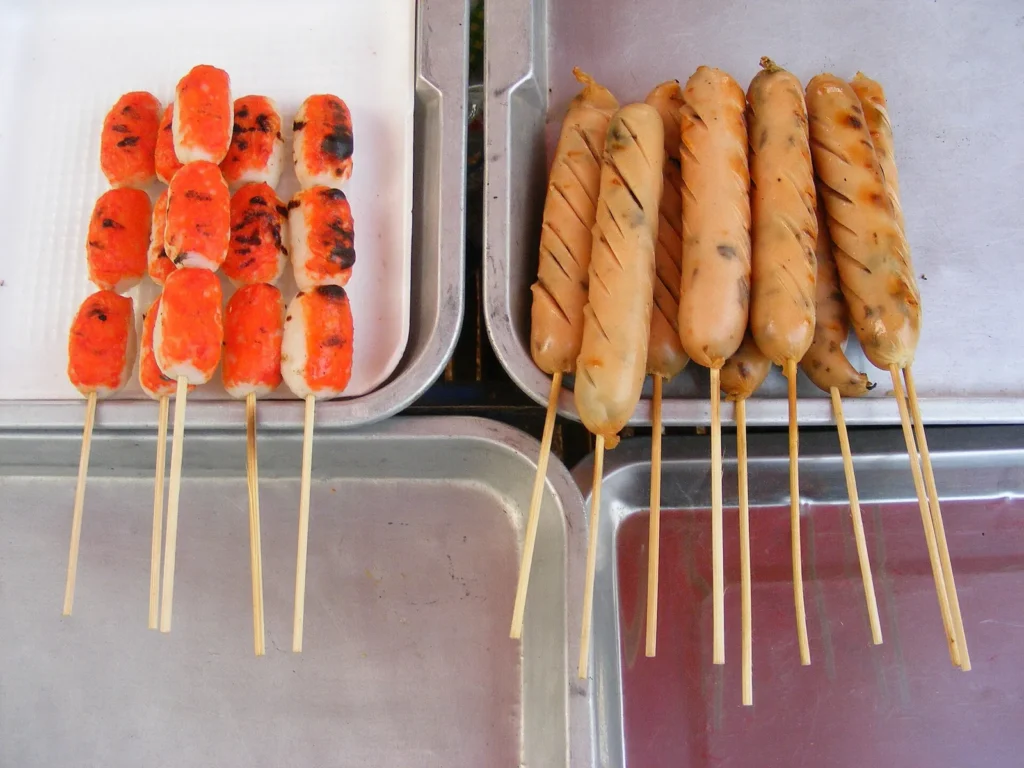
- Grilled skewers. Pork, chicken, fish balls and sausages from a charcoal grill.
- Mango sticky rice. Sweet coconut sticky rice with ripe mango, but only in season.
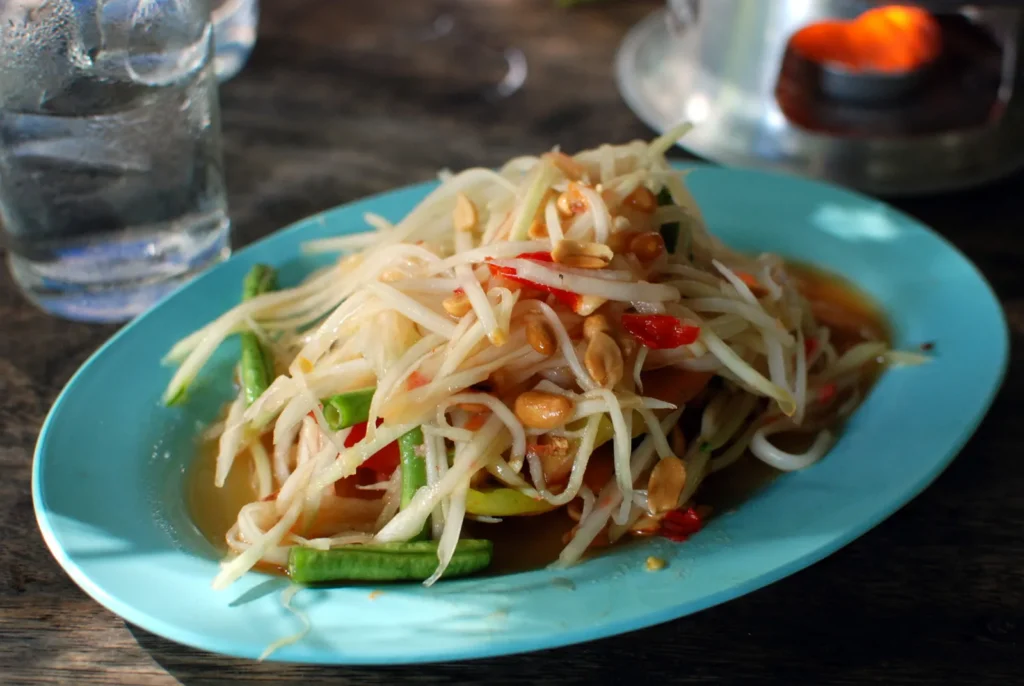
Many of these dishes come with condiments on the table. For instance, noodle shops usually offer sugar, chilli flakes, fish sauce and vinegar with chillies. So, taste first, then season to your liking.
How to order street food in Thailand
You do not need to speak Thai to order. However, this Thai street food guide suggests a few habits that make it much easier.
- Point. Point at the ingredients, the picture menu or another customer's dish.
- Say the spice level. "Mai phet" means not spicy, and "phet nit noi" means a little spicy.
- Say how many. Hold up fingers for the number of plates.
- Choose to stay or take away. "Kin tee nee" means eat here, and "sai toong" means take away.
- Pay. At carts you often pay when you collect, and at sit-down stalls when you finish.
A guide on Thailand-Property suggests using other tables as your menu, which works well when there is no English. In addition, write allergies down in Thai before you travel, because stall owners may not understand English terms.
Thai street food prices
Prices depend on the dish, the city and the area. Several 2026 travel guides put pad thai or som tam at roughly 40 to 80 baht at a street stall. A Chiang Rai Times report on Bangkok notes that prices climb faster on tourist streets. Therefore, walk one street back from the main sights to eat for less.
| Food | Rough street price | Notes |
|---|---|---|
| Pad thai or fried rice | About 40 to 80 baht | Shrimp costs more |
| Som tam | About 40 to 70 baht | Extra crab or salted egg costs more |
| Noodle soup | About 40 to 80 baht | "Special" bowls are bigger |
| Grilled skewer | About 10 to 30 baht each | Seafood costs more |
| Fresh fruit or shake | About 20 to 60 baht | Higher at the beach |
| Seafood by weight | Varies widely | Ask before it is cooked |
The numbers in this Thai street food guide come from travel guides, not official statistics. So, use them as a guide, and check the board before you order. For a full budget, read our guide to backpacking Thailand.
Is street food safe in Thailand?
Most travellers who follow a simple Thai street food guide eat street food every day without problems. Still, a few simple choices lower the risk. The Tourism Authority of Thailand's news site advises visitors to choose clean stalls and freshly cooked food.
- Pick busy stalls. They are best, because high turnover means fresher food.
- Watch it cooked. Hot food straight from the wok or grill is the safer choice.
- Be careful with raw seafood. Skip raw shellfish if you have a sensitive stomach.
- Drink sealed water. Ice in restaurants is usually factory-made, but ask if unsure.
- Wash your hands. Also carry hand gel or wet wipes.
If you have a food allergy, take extra care. For example, peanuts, shrimp paste and fish sauce appear in many dishes, even when you cannot see them.
Thai street food guide to etiquette
In general, Thai street food culture is relaxed. However, a few manners help. Share tables when it is busy, and do not hold a table for a long time at lunch. Also, eat with a spoon in your right hand and use the fork to push food onto it. Tipping is not expected at stalls, although rounding up is kind.
Where to find the best street food
Almost every town also has a night market or a morning market. Meanwhile, cities like Bangkok and Chiang Mai have whole streets of stalls. For the south, the companion pieces to this Thai street food guide cover Krabi street food, the Krabi night market and Phuket street food. In Bangkok, start with our Bangkok street food guide, and in the north read the Chiang Mai food guide.
Eating your way south to Krabi
Many travellers start in Bangkok and finish on the Andaman coast. Krabi is a good last stop for a food trip, because markets and seafood are close and prices are often lower than in Phuket. For example, a flight from Bangkok to Krabi is quick. Then, hotel and transfer listings put the drive from Krabi airport to Ao Luek at roughly 54 to 71 minutes. Our Krabi airport to Ao Luek guide has the details.
At a glance: 17 houses from 1,200 to 2,000 baht per night, air conditioning in every house, free breakfast, free Wi-Fi and a swimming pool, at 97/1 Moo 1, Ao Luek Nuea, Krabi.
We recommend Ban Kamnan Resort in Ao Luek Nuea. For a couple with a child, or three friends, House #4 and #9 each have one 5 ft bed and one 3.5 ft bed, one bathroom and 32 m², and they sleep three for 1,350 baht per night. Like every house, they have air conditioning. Also, guests share the swimming pool, and breakfast of toast, fried eggs and hot coffee is free. Prices match the resort's listing, so check your dates on Booking.com.
Frequently asked questions
Point at the dish or at another customer's plate, hold up fingers for the number, and say "mai phet" if you want it not spicy. Most vendors are used to visitors.
Several 2026 guides put a typical street dish at roughly 40 to 80 baht. Tourist areas and seafood cost more.
Usually, yes. Choose busy stalls, eat food cooked fresh and hot, drink sealed water and wash your hands.
Pad thai, som tam, pad kra pao, noodle soup and grilled skewers are among the most common street dishes across the country.
Final thoughts
Thai street food is one of the best reasons to visit Thailand. To sum up this Thai street food guide: point to order, set your spice level, choose busy stalls and carry small notes. Then, follow the food south to Krabi for seafood and southern curries. Check availability at Ban Kamnan Resort on Booking.com and end your food trip in quiet Ao Luek.