


 Krit Ariyathiti
Good Thai temple etiquette is simple once you know a few rules, and it makes every visit calmer for you and for the people who pray there. This guide explains the temple dress code Thailand expects, how to handle shoes in Thai temples, the strict Grand Palace dress code in Bangkok and basic Buddhist monk etiquette, with a short list of do's and don'ts you can read on the way.
Quick answer: Cover your shoulders and knees, take off your shoes before you enter any hall with a Buddha image, and keep your feet pointed away from Buddha images and monks. Speak quietly, never touch or climb a Buddha statue, and ask before you take photos of people. Women should not touch a monk or hand things to him directly, according to the Tourism Authority of Thailand. In short, dress modestly, move slowly and follow what local visitors do.
Why Thai temple etiquette matters
A Thai temple, or wat, is a working religious place. Monks live there, and local people come to pray, make merit and attend ceremonies. As a result, Thai temple etiquette is about respect, not about tourists. In addition, most temples are free or cheap to enter, so good behaviour is the best way to say thank you.
Rules are usually stricter at famous royal temples, such as those in Bangkok and Chiang Mai, than at small village wats. Still, the same basic Thai temple etiquette works everywhere.
Temple dress code Thailand: what to wear
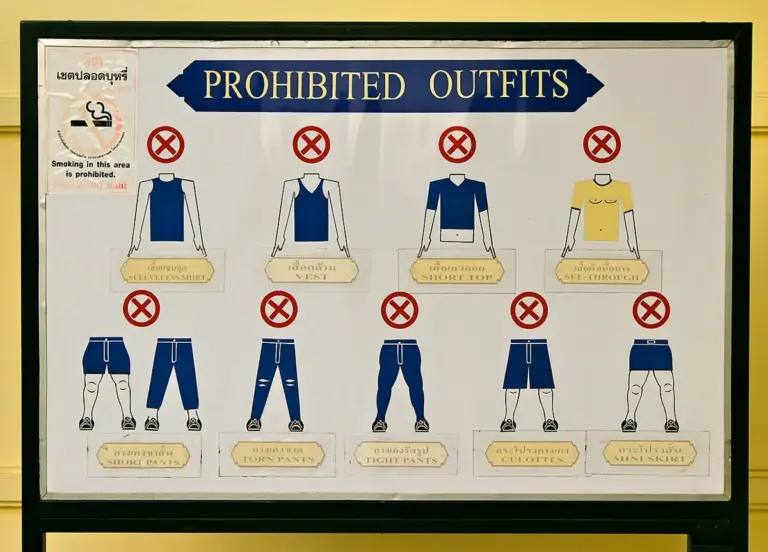
The temple dress code Thailand follows is the same for everyone: cover your shoulders and your knees. So, wear a shirt with sleeves and long trousers, a long skirt or a sarong.
- Do wear: T-shirts with sleeves, loose long trousers, long skirts, light scarves.
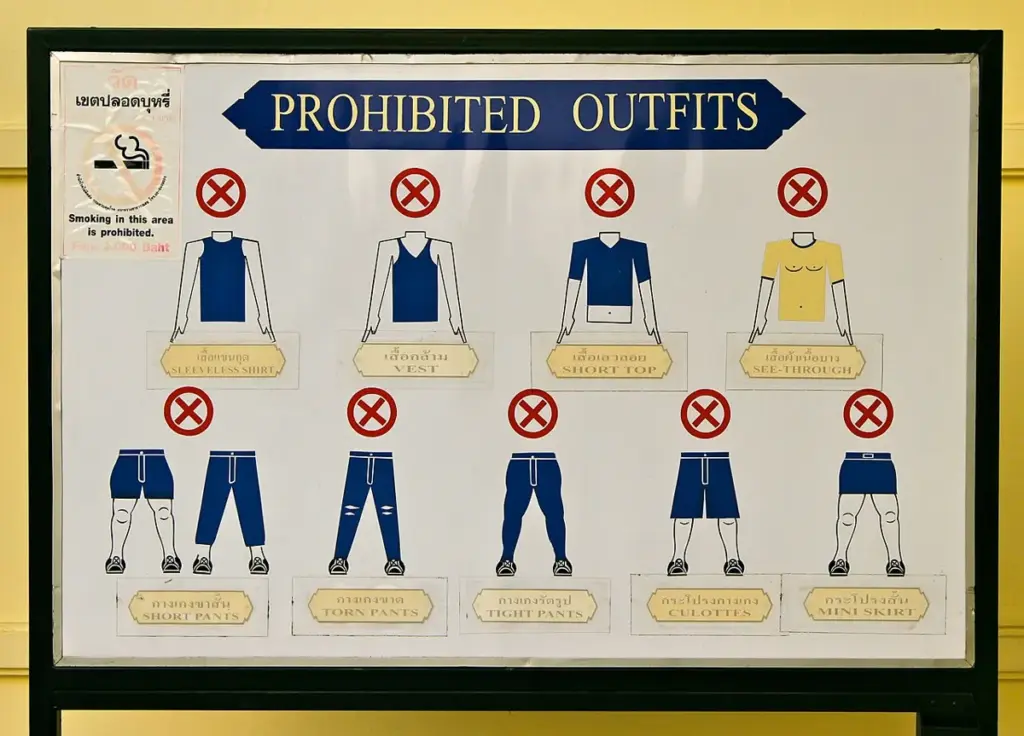
- Avoid: Tank tops, crop tops, short shorts, short skirts and see-through clothes.
- Bring a backup: A light scarf or sarong in your bag solves most problems.
Some large temples rent or lend cover-ups at the gate for a small fee. However, do not count on it. Instead, pack a scarf or long trousers before you leave your hotel.
Grand Palace dress code
The Grand Palace dress code in Bangkok is the strictest in the country, because the palace includes Wat Phra Kaew, the Temple of the Emerald Buddha. Signs at the entrance show what is not allowed. For example, sleeveless tops, shorts, ripped trousers and very tight leggings are usually refused.
So, dress conservatively from the start. In fact, it is easier to arrive in long trousers and a sleeved shirt than to queue for a cover-up. For the full visit, read our guide to things to do in Bangkok.
Shoes in Thai temples
Shoes in Thai temples come off before you enter any building that holds a Buddha image. Look for shoe racks, piles of sandals or signs at the steps. Then leave your shoes there and walk in barefoot or in socks.
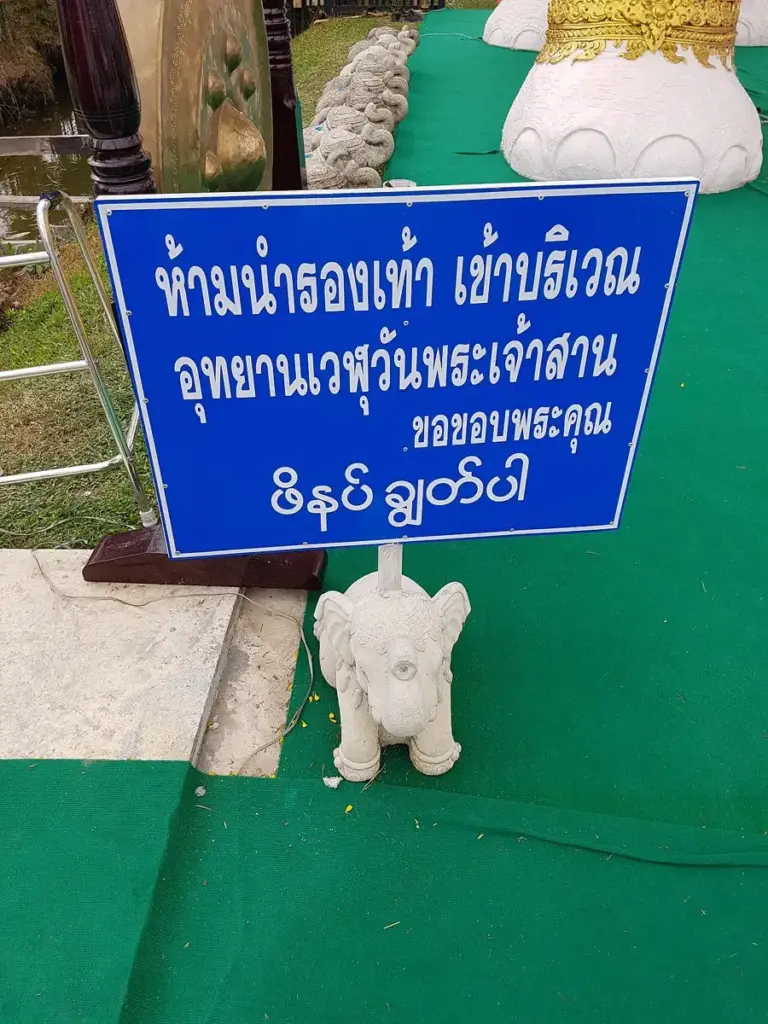
You can usually keep your shoes on in the open courtyard. Also, the Tourism Authority of Thailand notes that shoes are the norm for temple visits and that sandals should have a strap at the back. So, wear shoes that are easy to slip on and off, because you may remove them many times in one day.
- Step over the threshold. Thai custom is to step over, not on, the raised door sill.
- Keep socks clean. Floors can be hot or dusty outside.
- Watch your bag. Keep valuables with you, not beside your shoes.
Inside the hall: how to behave
Inside a prayer hall, keep your voice low and your movements slow. Then follow these simple rules of Thai temple etiquette.
- Sit with your feet tucked away. Feet are seen as the lowest part of the body, so never point them at a Buddha image or a monk.
- Keep your head lower. Guides advise that you should not stand above a seated Buddha or monk.
- Do not touch Buddha images. Never climb on statues or pose in a way that mocks them.
- Walk around, not through. Avoid walking in front of people who are praying.
- Ask before photos. Some halls do not allow photography, so read the signs.
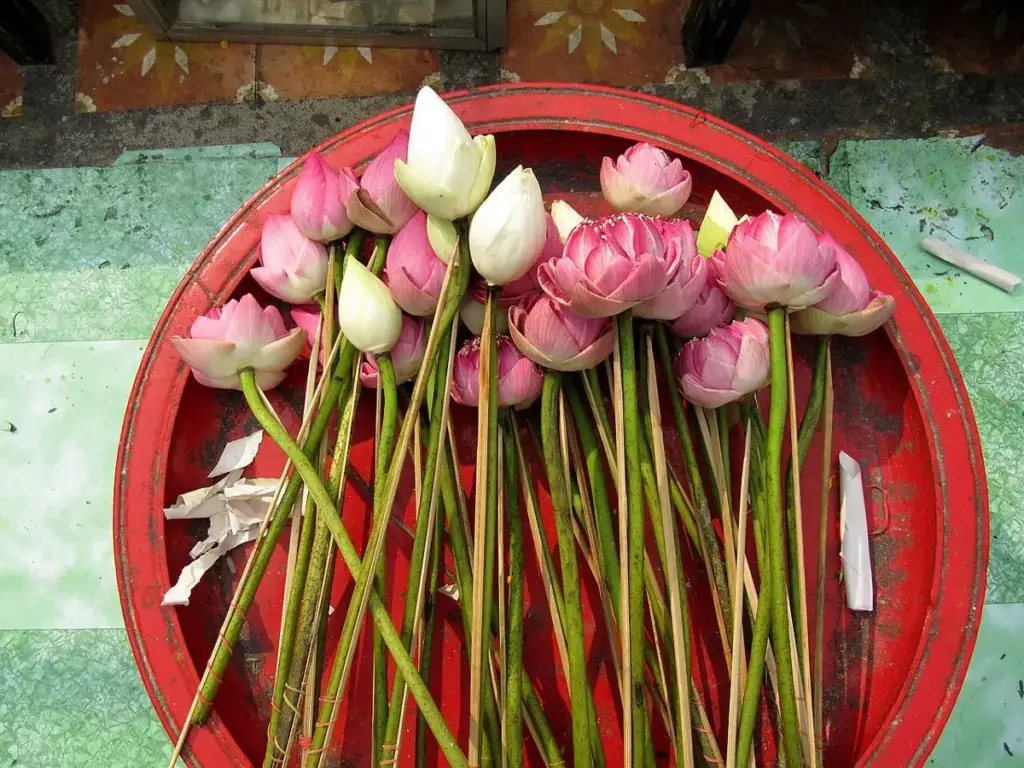
If you want to join in, you can buy a small set of flowers, incense and a candle at many temples. Then copy the people around you: kneel, place the offering, and bow three times with your hands together.
Buddhist monk etiquette
Monks follow many rules, and visitors should help them keep those rules. For this reason, Buddhist monk etiquette matters most for women.
- Women should not touch a monk. According to the Tourism Authority of Thailand, women are not allowed to touch a monk or his robes.
- Hand things over the right way. If a woman wants to give something to a monk, she can pass it to a man to hand over, or place it down for the monk to pick up, as TAT advises.
- Give monks space. On buses and boats, monks often have reserved seats, so leave them free.
- Be respectful at alms rounds. If you watch the morning alms round, stay quiet, keep a distance and do not use flash.
Monks are usually happy to chat in some temples, especially at "monk chat" programmes in Chiang Mai. Even so, keep the talk polite, and sit lower than the monk.
Quick do's and don'ts
| Do | Don't |
|---|---|
| — | — |
| Cover shoulders and knees | Wear shorts or sleeveless tops |
| Remove shoes before halls | Step on the door threshold |
| Sit with feet tucked behind you | Point feet at a Buddha or a monk |
| Speak quietly | Shout, smoke or play loud music |
| Ask before taking photos | Climb or touch Buddha images |
| Give monks space | Touch a monk, if you are a woman |
Temples to visit in the south
The same Thai temple etiquette applies in the south. For example, the climb at Tiger Cave Temple Krabi needs modest clothes at the top, and so do the caves of Wat Suwan Kuha in Phang Nga. Meanwhile, in Phuket, Wat Chalong and the Big Buddha Phuket both ask visitors to cover up. In the north, Doi Suthep is the temple most visitors see above Chiang Mai.
For general safety advice, read is Thailand safe, and for common tricks near famous temples, see our sibling guide to Thailand travel scams.
Visit the temples of Krabi from a quiet base
In Krabi, temples sit among limestone cliffs and caves, and many are near Ao Luek. So, a stay in the countryside makes temple mornings easy before the heat, and you can practise your Thai temple etiquette at small local wats. Ao Luek is about 54 to 71 minutes by road from Krabi airport, and our things to do in Ao Luek guide lists caves, pools and kayaking nearby.
At a glance: 17 houses from 1,200 to 2,000 baht per night, air conditioning in every house, free breakfast, free Wi-Fi and a swimming pool, at 97/1 Moo 1, Ao Luek Nuea, Krabi.
We recommend Ban Kamnan Resort in Ao Luek Nuea. For solo travellers or couples on a budget, House #5 and #6 each have one 5 ft bed, one bathroom and 28 m², for 1,200 baht per night. Every house has air conditioning, guests share the swimming pool, and breakfast of toast, fried eggs and hot coffee is free. Prices match the resort's listing, so check your dates on Booking.com.
Frequently asked questions
Cover your shoulders and knees. A T-shirt with sleeves and long trousers or a long skirt is the safest choice for everyone.
Yes, before you enter any hall with a Buddha image. You can usually keep your shoes on in the open courtyard.
No. The Tourism Authority of Thailand says women should not touch a monk or his robes, and should hand items through a man or place them down for the monk.
Often yes, but not everywhere. Read the signs, never use flash during prayers, and ask before you photograph people.
It is the strictest in Thailand. Sleeves and long trousers or a long skirt are needed, and shorts, sleeveless tops and ripped clothes are usually refused.
Final thoughts
In the end, Thai temple etiquette is mostly common sense and quiet respect. To sum up: cover up, take off your shoes, keep your feet down and give monks space. Then enjoy some of the most beautiful places in the country. Check availability at Ban Kamnan Resort on Booking.com and visit the cave temples of Krabi.








