


 Krit Ariyathiti

Doi Suthep is the forested mountain that rises behind Chiang Mai, and its golden temple near the top is the most famous sight in northern Thailand. This guide explains how to visit Wat Phra That Doi Suthep, how to get to Doi Suthep by red truck, car or on foot, what to expect on the Doi Suthep Monk's Trail and why the forest temple of Wat Pha Lat is worth a stop on the way up.
Quick answer: Go early in the morning by songthaew or ride-hailing car, climb the 306 naga steps (some sources say 309) or take the small funicular, and pay the temple fee, which most guides put at about 30 baht for foreigners, with some saying 50. In general, allow two to three hours for the visit. Alternatively, hike the Monk's Trail to Wat Pha Lat and continue up if you are fit. Above all, cover your shoulders and knees.
Why Doi Suthep is Chiang Mai's top sight
Doi Suthep is part of Doi Suthep-Pui National Park, west of the old city. According to Wikipedia, the temple sits about 15 km from Chiang Mai. From the terrace, you look over the whole valley, and on a clear morning the city spreads out below the forest.
In addition, the temple is deeply sacred to Thai people. As a result, you will see families making offerings, monks walking the terraces and pilgrims circling the golden chedi. So, treat the visit as a temple visit first and a viewpoint second.

For the wider city, read our guide to things to do in Chiang Mai, which puts Doi Suthep alongside the old city temples and markets.
Wat Phra That Doi Suthep: history and legend
Wat Phra That Doi Suthep dates back to the Lanna kingdom in the late 14th century, although sources give slightly different years. The best known legend tells of a relic of the Buddha placed on the back of a white elephant. According to the story, the elephant climbed the mountain, trumpeted three times and died at the spot where the temple now stands.
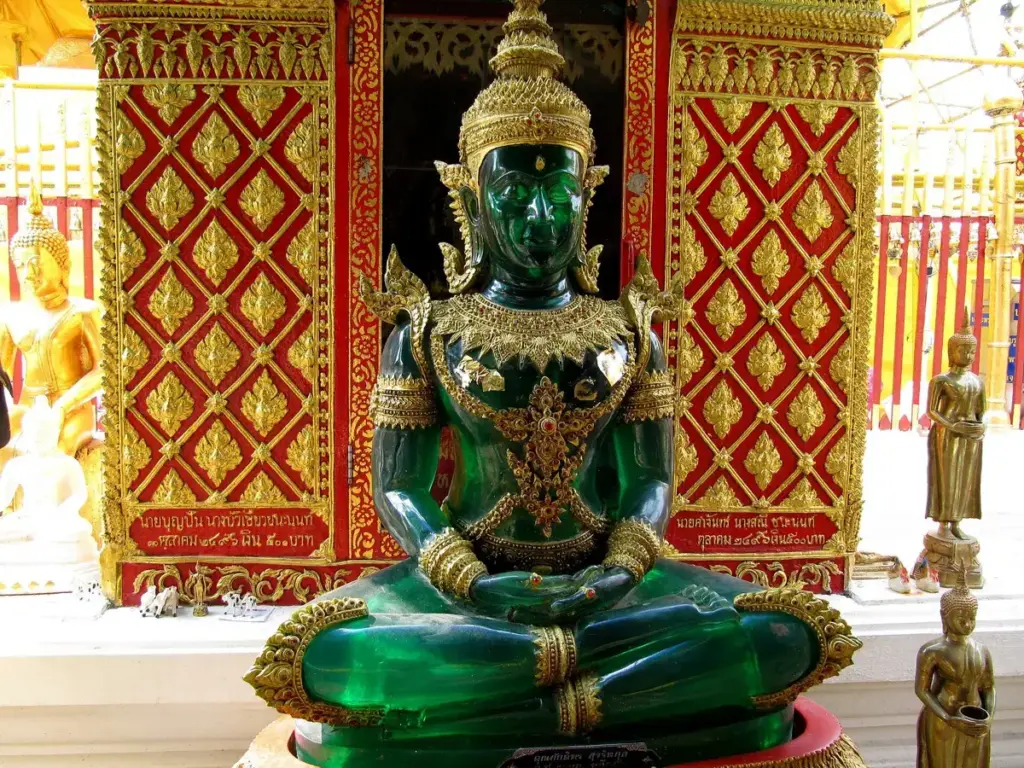
Today, the golden chedi at the centre holds the relic. Around it, you also find shrines, bells, Buddha images and murals. For example, many visitors walk around the chedi three times in a clockwise direction, carrying lotus flowers and incense.
How to get to Doi Suthep
There are four common ways for how to get to Doi Suthep from the city. In general, each one starts in the old town or near Chiang Mai University, at the foot of the mountain road.
| Option | Time from the city | Typical cost (hedged) |
|---|
|—|—|—|
| Red songthaew, shared | About 30 to 40 minutes | About 50 baht per person one way when full, per one guide |
|---|---|---|
| Grab or Bolt car | About 30 minutes | Varies by demand |
| Motorbike or rental car | About 30 minutes | Fuel and parking |
| Hike via the Monk's Trail | 1 to 4 hours, depending on how far you walk | Free |
Songthaews wait near the university zoo area and leave when they fill up. However, prices change and drivers may ask more for a private trip, so agree the fare before you get in. Also, the mountain road has many bends, so take care if you ride a motorbike yourself.
The national park fee
Chiang Mai City Life reported that Doi Suthep-Pui National Park began charging fees in October 2025, with 100 baht for foreign adults. However, the same report says visitors who go only to Wat Doi Suthep and Wat Pha Lat by the main road do not pay that fee. Since the rule is new, check it on the day.
The Doi Suthep naga staircase
First, from the car park, a long staircase leads up to the temple. Its handrails, meanwhile, are two great naga serpents with green and gold scales. Most guides count 306 steps, while some say 309. Either way, the climb takes about 10 to 15 minutes at a steady pace.
Alternatively, a small funicular runs beside the stairs. One guide lists a fare of about 50 baht for foreigners, while another quotes 20 baht. So, carry small notes, and check the price at the ticket window.
Doi Suthep Monk's Trail and Wat Pha Lat
The Doi Suthep Monk's Trail is a forest path that starts near the end of Suthep Road, behind Chiang Mai University. Then it climbs through shady forest to Wat Pha Lat, a quiet temple beside a stream and small waterfall. According to one guide, most walkers reach Wat Pha Lat in 30 to 60 minutes.
After that, a steeper section continues to the road near the main temple. One guide puts the whole route at roughly 6 to 7 km with about 600 m of climbing, and allows three to four hours one way with stops. Therefore, start early, wear good shoes and carry water.
Why stop at Wat Pha Lat
Wat Pha Lat feels very different from the busy temple at the top. Instead of crowds, you find moss-covered statues, old chedis and the sound of running water. In fact, legend says the white elephant rested here on its way up the mountain. So, even if you do not hike, it is a calm place to visit.
Doi Suthep opening hours and fees
Opening hours differ between sources. For example, some list about 05:00 to 21:00, while others give 06:00 to 20:00 or close at 18:00. Meanwhile, the funicular usually runs from about 06:00 to 18:00. In short, plan your visit between 07:00 and 17:00, and you will be fine.
The temple fee for foreigners is about 30 baht in most guides, though some say 50 baht. Thai nationals, however, usually enter free.
Best time to visit Doi Suthep
Early morning is best. For one thing, the air is cooler and the light is soft. Also, you beat the tour buses that arrive later in the morning. In the cool season, from about November to February, the view is often clearer, and mist may lie in the valley at dawn.
Sunset is also popular. However, the road and the terraces are busier, and you need transport back to the city after dark. Meanwhile, in the burning season of about March and April, smoke can hide the view, so check air quality before you go.
What to wear and temple etiquette
- Cover up. Shoulders and knees must be covered; sarongs are often available to borrow.
- Remove shoes. Take them off before you enter halls and the inner terrace.
- Walk clockwise. Also, circle the chedi with it on your right.
- Be quiet. Also, lower your voice in prayer areas.
- Do not point your feet. Sit with your feet tucked away from Buddha images.
Tips for visiting Doi Suthep
- Go before 9:00. You avoid crowds and heat.
- Bring small notes. Fees, the funicular and songthaews are cash, so carry baht.
- Combine with Wat Pha Lat. Then stop on the way down by car or on foot.
- Eat in the city. Then try khao soi from our Chiang Mai food guide.
- Plan the evening. On Sundays, the Chiang Mai Sunday Walking Street fills the old town.
For a base close to the mountain road, compare the areas in where to stay in Chiang Mai.
Continue south to Krabi after Chiang Mai
After the mountains of the north, many travellers want the sea. Then flights link Chiang Mai with Krabi, often with a change in Bangkok, depending on the season. From Krabi airport, Ao Luek is about 54 to 71 minutes by road, depending on traffic. There, limestone cliffs, mangrove rivers and clear pools wait, as our things to do in Ao Luek guide shows.
At a glance: 17 houses from 1,200 to 2,000 baht per night, air conditioning in every house, free breakfast, free Wi-Fi and a swimming pool, at 97/1 Moo 1, Ao Luek Nuea, Krabi.
We recommend Ban Kamnan Resort in Ao Luek Nuea as the next leg of your trip. For couples on a budget, House #5 and #6 each have one 5 ft bed, one bathroom and 28 m², for 1,200 baht per night. Like every house, they have air conditioning. Also, guests share the swimming pool, and breakfast of toast, fried eggs and hot coffee is free. Prices match the resort's listing, so check your dates on Booking.com.
Frequently asked questions
Most guides list about 30 baht for foreigners, and some say 50 baht. Thai nationals usually enter free. Also, the funicular costs extra, between about 20 and 50 baht, depending on the source.
Most guides count 306 steps on the naga staircase, while some say 309. The climb takes about 10 to 15 minutes, or you can take the funicular.
Yes. The Monk's Trail starts near Chiang Mai University and reaches Wat Pha Lat in about 30 to 60 minutes. After that, the full route to the main temple takes about three to four hours.
According to a Chiang Mai City Life report, visitors who go only to Wat Doi Suthep and Wat Pha Lat by the main road do not pay the park fee. Check the rule on the day.
Cover your shoulders and knees, and wear shoes that are easy to remove. Also, sarongs are often available to borrow at the entrance.
Final thoughts
Doi Suthep is the one visit every Chiang Mai trip needs. To sum up: go early, climb the naga steps, walk around the golden chedi and stop at Wat Pha Lat on the way down. Then swap the mountains for the cliffs of the south. Check availability at Ban Kamnan Resort on Booking.com and plan the Krabi leg of your trip.








