


 Krit Ariyathiti
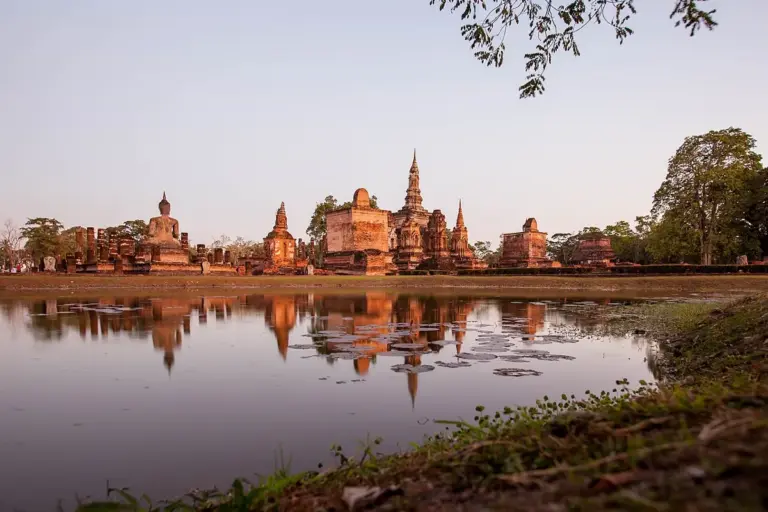
Sukhothai Historical Park protects the ruins of the capital of the first Thai kingdom, with lotus-bud chedis, seated Buddhas and quiet lakes spread across a flat plain in northern Thailand. This guide explains the Sukhothai entrance fee and zones, what to see at Wat Mahathat Sukhothai and the Wat Si Chum Buddha, and how to explore the Sukhothai ruins by bicycle, so you can plan one or two days among the temples.
Quick answer: Sukhothai Historical Park is a UNESCO World Heritage Site, inscribed in 1991. Thai Holiday Guide (updated June 2026) lists foreign adult tickets at 200 baht for the central zone, 120 baht for each outer north and west zone and 400 baht for all three, while older guides show 100 baht per zone. Hours are given as 06:00 to 18:00 or 06:30 to 19:30, depending on the source. Dress for temples, as in our Thai temple etiquette guide. As of November 2026, check prices at the gate.
What is Sukhothai Historical Park?
Sukhothai was the centre of Tai power in the 13th and 14th centuries, according to Wikipedia. A local chief led a rebellion against Khmer rule in 1238, and King Ramkhamhaeng is said to have invented Thai script in 1283. Later, Ayutthaya's armies forced King Thammaracha II to submit in 1378. As a result, Thai Holiday Guide credits Sukhothai with the birth of Thai script, art and Theravada Buddhist architecture.
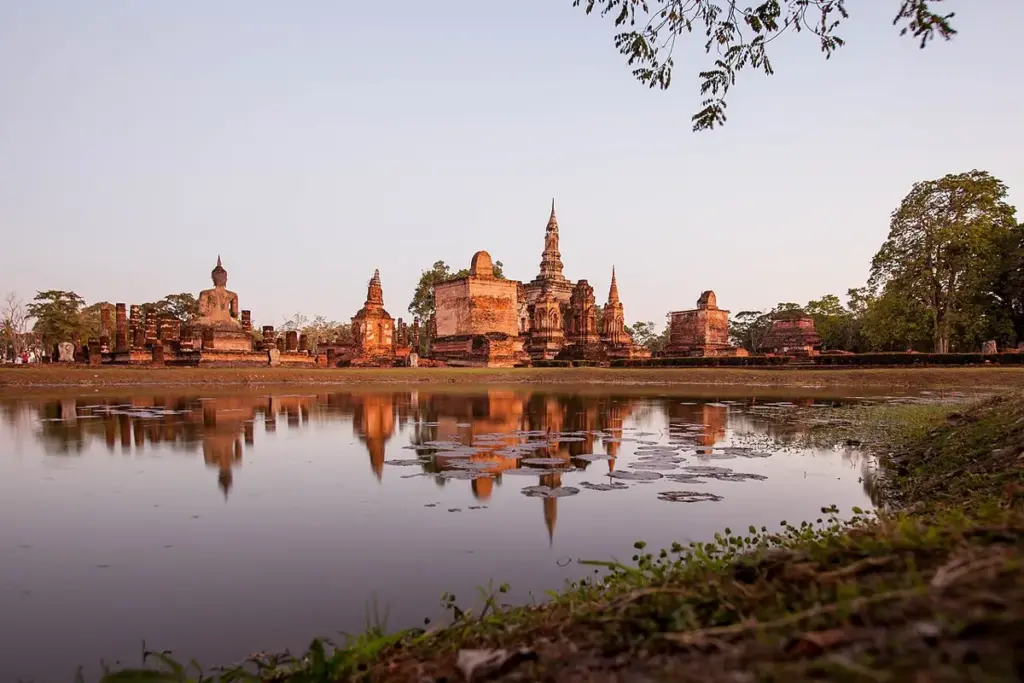
The park is the old walled city plus its surroundings. Wikipedia counts 193 ruins and describes city walls of about 2 km by 1.6 km, with a gate in the middle of each wall. UNESCO listed the site on 12 December 1991 as part of the Historic Town of Sukhothai and Associated Historic Towns. In addition, the Fine Arts Department of Thailand looks after the ruins.
Sukhothai entrance fee, zones and opening hours
The Sukhothai entrance fee depends on the zone, and each zone sells its own ticket. Thai Holiday Guide lists these prices for foreign visitors.
| Zone | Foreign adults | Thai nationals |
|---|---|---|
| Central | 200 baht | 20 baht |
| Outer north | 120 baht | 20 baht |
| Outer west | 120 baht | 20 baht |
| All three combined | 400 baht | 40 baht |
Prices change, and sources do not agree. Some older guides list a flat 100 baht per zone and 10 baht for a bicycle, and one source says the east zone is free. So, treat the table as a guide and ask at the ticket office. Also, the ticket counter may close earlier than the gates, according to one source.
Hours are also uneven. Thai Holiday Guide says 06:00 to 18:00 daily, while Visit Thailand Today says 06:30 to 19:30 and suggests checking Thai public holidays. Therefore, arrive early. A morning start also gives cooler air and softer light.
Wat Mahathat Sukhothai: the royal temple
Wat Mahathat Sukhothai is the royal temple at the heart of the central zone, and it is the largest temple in the old city, according to Wikipedia. Thai Holiday Guide describes a lotus-bud chedi and rows of seated Buddhas. In short, it is the obvious place to start.
Visit Thailand Today suggests a full, unhurried hour here and an arrival at opening time. That advice makes sense, because the central zone holds the headline ruins. In addition, an early start gives you cooler air and softer light for photos.
Wat Si Chum Buddha and the north zone
The Wat Si Chum Buddha, known as Phra Achana, is a seated Buddha almost 15 m tall inside a roofless brick mondop. Thai Holiday Guide places it in the north zone. Because the mondop has no roof, daylight reaches the Buddha directly.
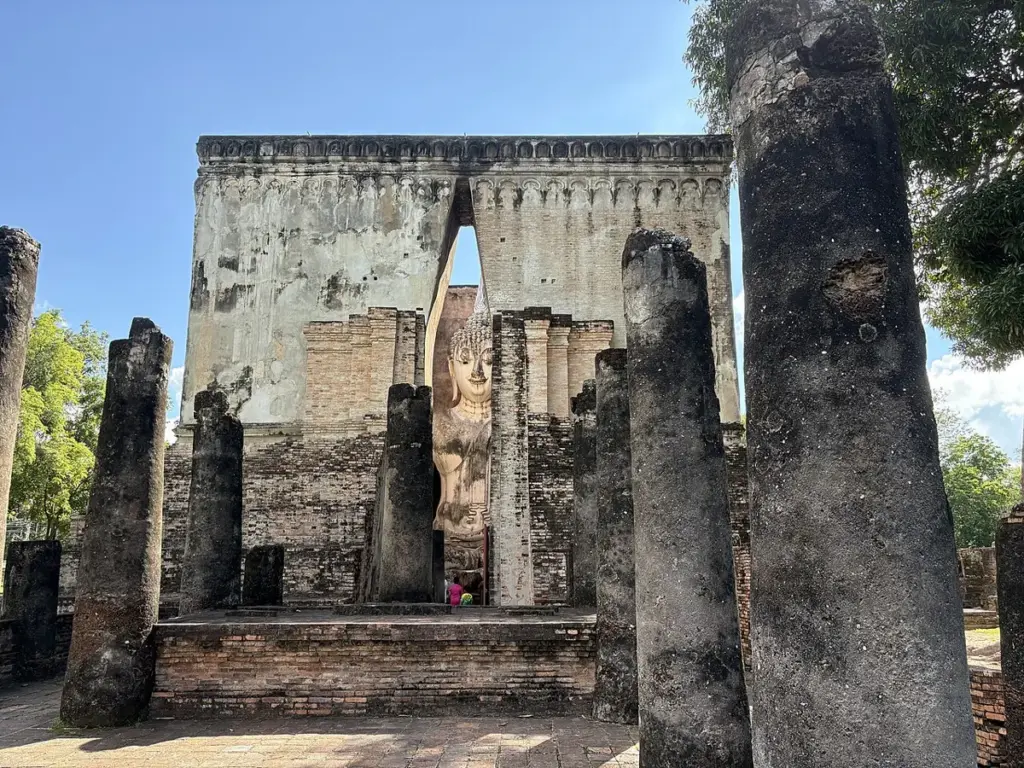
If other visitors are waiting, step aside after your photo. Meanwhile, stay quiet and keep your head lower than the Buddha image, as you would at any active temple. Also, remember that the north zone needs its own ticket, so keep the receipt.
Other temples worth your time
The central zone holds several short stops. Together they show different styles within a small area.
- Wat Sa Si: Set on an island in a pond, with a walking Buddha, according to Thai Holiday Guide.
- Wat Chang Lom: Known for the elephants around the base of its chedi, and listed among the notable temples on Wikipedia.
- Wat Sorasak: An elephant-base chedi in the old city, according to Visit Thailand Today.
- Wat Saphan Hin: In the west zone, reached by climbing into the hills.
- Ramkhamhaeng Monument: A memorial to the king in the old city.
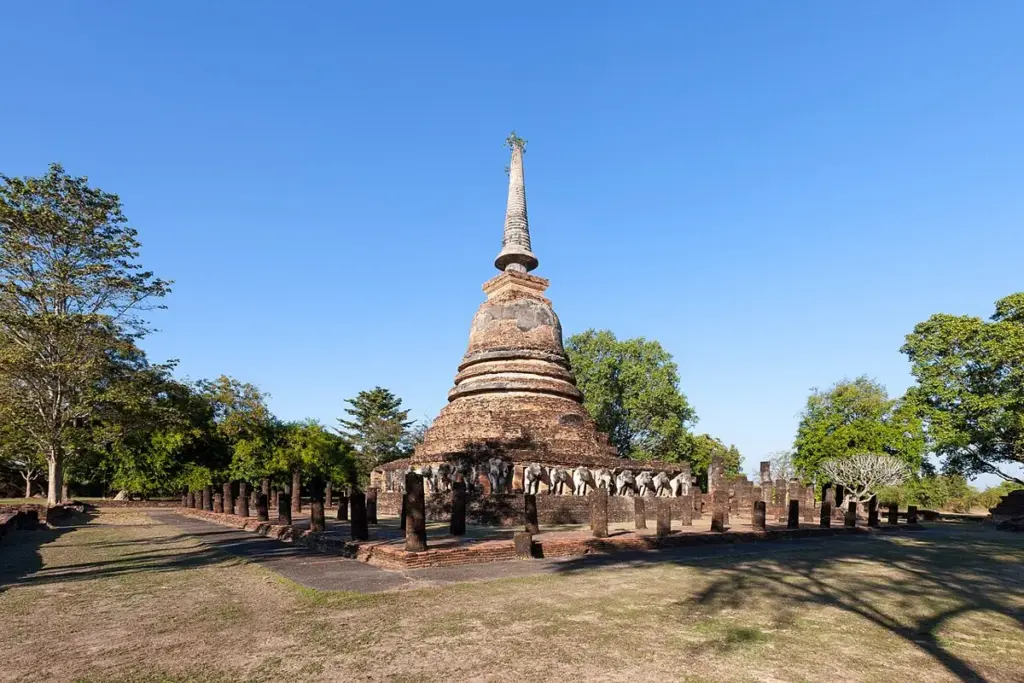
Since the sights sit close together, a half day can cover the central zone. However, the outer zones are spread out, so plan about another half day for them, according to Visit Thailand Today. If you like temples, our Wat Pho and Wat Arun guides cover two famous Bangkok sites, and Wat Chedi Luang is a Chiang Mai option.
Sukhothai ruins by bicycle
You can see the Sukhothai ruins by bicycle. The ground is flat, and rental shops sit just outside the gate of the central zone, according to Thai Holiday Guide. Visit Thailand Today lists a bicycle at about 50 baht per day at the gate, and another guide gives 30 to 50 baht, so prices vary.
You have other options too:
- Electric tram: Visit Thailand Today says a tram runs inside the park, but it gives no price.
- Motorbike: About 250 baht per day for outlying ruins, according to the same source.
- On foot: The central zone is compact enough to walk if you stay in one area.
Because shade is limited, bring water and a hat. Also, check your brakes before you go. Some older price lists add 10 baht per bicycle at the ticket gate.
How to get to Sukhothai Historical Park
The old city is about 12 km west of New Sukhothai, the modern town. Songthaews and Grab connect the two, and Visit Thailand Today puts a songthaew at about 30 minutes for 30 baht. So, you can stay in the new town and travel to the park each morning.
From the rest of Thailand:
- Bangkok by air: Bangkok Airways flies to Sukhothai Airport in about 70 minutes, according to Visit Thailand Today.
- Bangkok by bus: Direct buses from Mo Chit take 6 to 7 hours.
- Chiang Mai by bus: Direct buses take 5 to 6 hours.
- Phitsanulok: Visit Thailand Today says many travellers fly here instead, then take a bus of about an hour.
If you are building a longer trip, our Chiang Mai old city and things to do in Chiang Mai guides fit well before or after Sukhothai. In the other direction, Ayutthaya day trip covers another former capital.
Best time to visit Sukhothai Historical Park
Visit Thailand Today recommends November to February and warns against March to May because of extreme heat. May to October is the rainy season. In addition, Thai Holiday Guide suggests sunrise and late afternoon, when light is softer and morning mist often lingers over the moats.
Sukhothai also hosts a Loy Krathong event. Thailand.go.th lists the 2026 event at Sukhothai Historical Park from 15 to 24 November. So, if you travel in that window, book a room early and plan your return transport after dark. Our Loy Krathong guide explains the festival.
Etiquette at Sukhothai Historical Park
Sukhothai's ruins are historic, but many are still revered sites. So, cover your shoulders and knees, according to Visit Thailand Today. Take your shoes off before entering any building with a Buddha image, and carry a light scarf or sarong, since not every temple lends wraps. In addition, do not climb on the ruins or sit on Buddha images.
Where to stay: continue south to Krabi
Sukhothai is in the north, so Krabi is a separate leg of a Thailand trip. After the ruins, you can fly south for beaches and limestone scenery. From Krabi airport, Ao Luek is about 54 to 71 minutes by road, depending on traffic. Then our Bangkok to Krabi guide explains the route, and Krabi airport to Ao Luek covers the transfer.
At a glance: 17 houses from 1,200 to 2,000 baht per night, air conditioning in every house, free breakfast, free Wi-Fi and a swimming pool, at 97/1 Moo 1, Ao Luek Nuea, Krabi.
We recommend Ban Kamnan Resort in Ao Luek Nuea as a trial slow stay or a first base near Krabi. For two people, House #E, #F and #G each have one 6 ft bed, one bathroom and 35 m², and they sleep two for 1,350 baht per night. Also, like every house, they have air conditioning. In addition, guests share the resort's swimming pool, and breakfast of toast, fried eggs and hot coffee is free. Prices match the resort's listing, so check your dates on Booking.com.
Frequently asked questions
Thai Holiday Guide lists 200 baht for the central zone and 120 baht for the north and west zones, with a 400 baht combined ticket for foreigners. Older guides show 100 baht per zone, so confirm at the ticket office.
One day covers the central zone and a few highlights. Two days give time for the outer zones and an early or late visit for better light.
Yes. Bicycles are rented near the gate for about 30 to 50 baht per day, according to different sources, and the land is flat. Bring water and a hat.
Visit Thailand Today recommends November to February. March to May is very hot, and May to October is the rainy season.
Fly to Sukhothai Airport in about 70 minutes, take a bus of 6 to 7 hours from Mo Chit, or fly to Phitsanulok and take a bus of about an hour.
Final thoughts
Sukhothai Historical Park rewards a slow visit. To sum up: choose your zones, rent a bicycle, start early and dress respectfully. Then, when you head south, check availability at Ban Kamnan Resort on Booking.com and plan your Krabi leg.








