

 Krit Ariyathiti
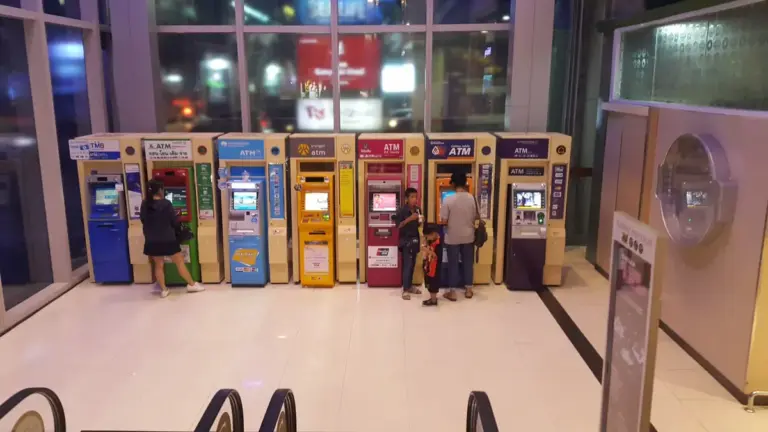
ATM fees in Thailand catch almost every visitor by surprise, because the machine adds its own charge on top of whatever your home bank takes. This guide shows what Thai banks charge foreign cards, how dynamic currency conversion works, what the ATM withdrawal limit in Thailand usually is and how to cut the cost of foreign card fees in Thailand. It also shows where to find cash machines in Thailand. It is general information, not financial advice.
Quick answer: As of November 2026, a Thai bank's own notice shows the pattern. SCB's 2026 fee table lists 250 baht per withdrawal for a foreign Visa or JCB card and 350 baht for a foreign Mastercard (from 26 March 2026). Other banks are reported to charge similar amounts, but we could not confirm each one, and older pages still say 220 baht. The fee on the ATM screen is the one you pay, and you can cancel before you confirm. Withdraw larger amounts less often, and always decline the machine's currency conversion.
What ATM fees in Thailand look like
Thai banks charge a fee for each withdrawal made with a card issued abroad. The fee is not a percentage. It is a flat charge per transaction, so ATM fees in Thailand weigh more on a small withdrawal.
| Source | Visa | Mastercard | JCB | Notes |
|---|---|---|---|---|
| SCB fee table (Thai, 2026) | 250 baht | 350 baht | 250 baht | Mastercard from 26 March 2026, JCB from 11 March 2026 |
| Other major banks | Reported about 250 baht | Reported 250 to 350 baht | Varies | Based on 2026 guides, not confirmed on each bank's page |
| Older guides | 220 baht | 220 baht | 220 baht | Long-standing figure, now often outdated |
So the ATM fees in Thailand that you pay depend on your card network and the bank that owns the machine. For example, one Mastercard withdrawal at SCB costs 350 baht, while a Visa one costs 250 baht. Check the official fee page of the bank whose machine you plan to use, and read the screen. Our money in Thailand guide covers cards, cash and tipping in general.
Why the fee per withdrawal matters
The flat fee punishes small withdrawals, so ATM fees in Thailand add up fast. A 250 baht fee on a 5,000 baht withdrawal is 5%, but on a 20,000 baht withdrawal it is 1.25%. Therefore, fewer and larger withdrawals are the simplest saving.
ATM withdrawal limit in Thailand
The ATM withdrawal limit in Thailand is set by the bank that owns the machine and by your own card. Many machines allow up to 20,000 baht per transaction, and some allow more. Your home bank may also cap daily cash withdrawals abroad, so ask before you travel.
If the machine refuses a large amount, try a smaller one, or try another bank's machine. However, do not repeat the withdrawal several times in a row, because each success adds a fee. Ask your home bank for your limit before you travel.
Dynamic currency conversion: always decline
Dynamic currency conversion, or DCC, is the offer to bill you in your home currency instead of Thai baht. It sounds helpful, but the exchange rate includes a markup. Visa says you can accept or decline, and that the ATM must show the amount in both currencies, the exchange rate and any extra fees, and must not choose for you. Visa recommends declining if the details are missing or you feel pressured. Mastercard's guidance is similar: let your own bank do the conversion.
So choose "no conversion" or "charge in Thai baht". Your own bank then applies its rate, which is usually better than the machine's.
Foreign card fees in Thailand: the full picture
The ATM fee is only one of the foreign card fees in Thailand. Your home bank may add its own charges, so the total can include:
- The Thai bank's flat fee shown on the ATM screen.
- Your home bank's foreign cash withdrawal fee, which may be a flat amount, a percentage or both.
- A foreign transaction fee on the conversion, which depends on your card terms.
- The exchange rate itself, which is better when you decline DCC.
Because these vary, check your card's terms. Some cards refund ATM fees or have no foreign transaction fee, but that is a feature of your own account, not of Thailand. Also tell your bank that you are travelling, so the card is not blocked.
Cash machines in Thailand: where and how
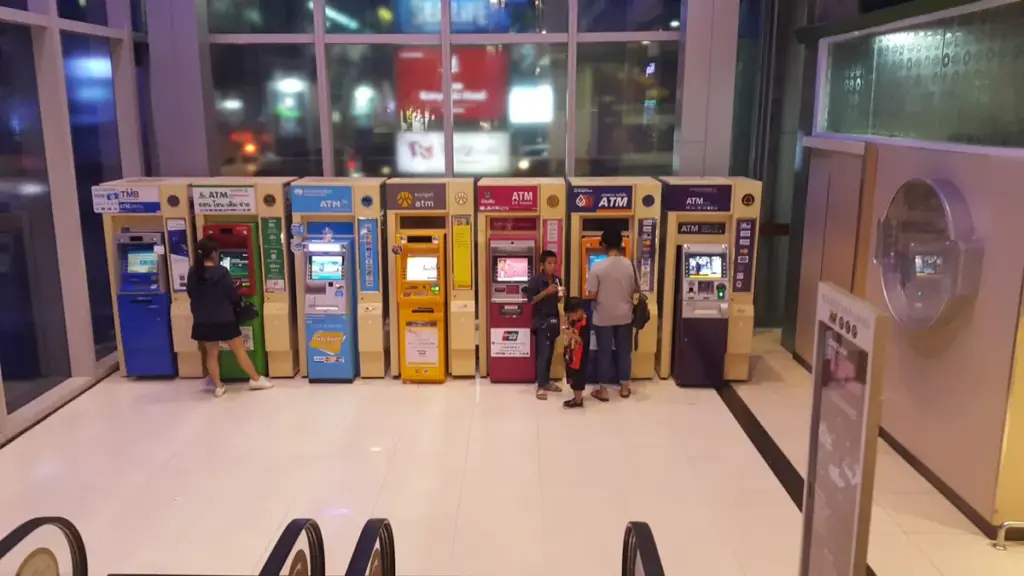
Cash machines in Thailand are everywhere in cities, malls and tourist towns, and in 7-Eleven stores. Small islands and rural areas have far fewer, and some have none. Our Koh Jum guide, for example, advises carrying cash and not relying on machines.
- Prefer machines at bank branches or inside malls. They are easier to use safely, and staff can help if a card is kept.
- Cover the keypad. Shield your PIN with your hand.
- Check the card slot. If anything looks loose, use another machine.
- Take your card and receipt before you leave.
Ways to spend less on ATM fees in Thailand
You cannot avoid ATM fees in Thailand at a Thai bank, but you can pay them less often.
- Plan one large withdrawal for several days, and keep the cash in a room safe.
- Pay by card in malls, hotels and bigger restaurants. Some places add a small surcharge, so ask first.
- Bring some cash from home and change it at a booth in town. Booths in town usually beat airport rates.
- Use mobile data to check your bank's app. Our Thailand eSIM guide explains how to get online on arrival.
- Budget before you arrive. Our Thailand travel costs guide gives typical daily spending.
Where to stay when you want fewer cash trips
A quiet base with free breakfast cuts daily spending, so you meet fewer ATM fees in Thailand and need less cash. Ao Luek, in the north of Krabi province, is cheaper than the busy beach towns, and the Krabi airport is about 54 to 71 minutes away by road, according to transfer listings. Our Krabi on a budget guide has more ideas.
At a glance: 17 houses from 1,200 to 2,000 baht per night, air conditioning in every house, free breakfast, free Wi-Fi and a swimming pool, at 97/1 Moo 1, Ao Luek Nuea, Krabi.
We recommend Ban Kamnan Resort in Ao Luek Nuea. For a couple, House #5 and #6 each have one 5 ft bed, one bathroom and 28 m², and they sleep two for 1,200 baht per night. Like every house, they have air conditioning. Guests share the swimming pool, and breakfast of toast, fried eggs and hot coffee is free. Prices match the resort's listing, so check your dates on Booking.com.
Frequently asked questions
SCB's 2026 fee table lists 250 baht for a foreign Visa or JCB card and 350 baht for a foreign Mastercard. Other banks are reported to charge similar amounts, while older guides say 220 baht. Read the fee on the screen before you confirm.
Not at Thai bank machines, because the fee applies to foreign cards. You can reduce the cost by withdrawing larger amounts less often, paying by card where accepted and checking whether your home bank refunds ATM fees.
It depends on the bank and your card. Many machines allow about 20,000 baht per transaction, and some allow more. Your home bank may set a lower daily limit.
No. Visa and Mastercard both advise declining the machine's offer and letting your own bank convert, because the machine's rate includes a markup.
Large islands have some, but small islands may have few or none. Carry enough baht from the mainland for food, boats and park fees.
Final thoughts
ATM fees in Thailand are flat charges that hurt small withdrawals most. To sum up how to handle ATM fees in Thailand: check the fee on the screen, decline currency conversion, withdraw larger amounts less often and confirm your card's terms with your bank. This is general information, not financial advice, so check the bank notices that apply to your card. Then enjoy a quiet, low-cost stay. Check availability at Ban Kamnan Resort on Booking.com and plan your Krabi trip.