

 Krit Ariyathiti
A Thailand re-entry permit lets a foreigner leave the country and come back without losing the stay already granted. Most short-stay visitors never need one, but it matters once you hold an extension of stay or a single-entry visa. This guide explains the single re-entry permit and the multiple re-entry permit. It covers what they cost (the re-entry permit fee), how the TM.8 form works and what happens if you skip it. If you are extending a tourist stay first, read our Thailand visa extension guide.
Quick answer: As of November 2026, the Bangkok Immigration Division fee page lists 1,000 baht for a single re-entry permit. It lists 3,800 baht for a multiple one. Also, Section 39 of the Immigration Act says that if a foreigner leaves, the temporary stay permission ends, unless re-entry was granted before leaving. Then the remaining days continue. The permit adds no days. This is general information, not legal or visa advice, so confirm details with the Immigration Bureau.
What is a Thailand re-entry permit?
A Thailand re-entry permit is permission to leave and return within a stay you already hold. In law, Section 39 of the Immigration Act B.E. 2522 (1979) sets the rule. According to the Council of State's unofficial English translation, leaving the Kingdom ends the temporary stay permission. However, if the officer granted re-entry before departure, and the foreigner is not a prohibited person, the remaining time continues.
In other words, the permit protects days you already have. Meanwhile, it does not extend them, and it does not replace a visa. Several guides add that it lapses if the underlying permission expires while you are abroad.
Who needs a Thailand re-entry permit?
The answer depends on your visa category. Also, sources are mostly law firms and visa guides, not the Immigration Bureau. So, treat the list as a starting point.
- Extension holders. One guide says anyone with an extension of stay must get a permit before leaving, or the extension ends on departure.
- Single-entry long visas. Guides list Non-Immigrant B, O and ED visas, which are single-entry unless issued as multiple.
- Visa-exempt tourists without an extension. Guides are not consistent here. Some practitioner tables say a permit is not needed, because the stay simply ends and a new entry gets a new stamp if you qualify again. Ask the Immigration Bureau about your case.
- Multiple-entry visas. Guides say holders of the Destination Thailand Visa (DTV), the Long-Term Resident (LTR) visa and the Thailand Privilege (Elite) visa are usually covered for the stay granted at entry. Our Thailand DTV visa and Thailand Privilege visa guides explain those categories.
Because the rules differ by category, ask the Immigration Bureau about your own passport. As of November 2026, the Tourism Authority of Thailand lists a 30-day visa exemption for 60 countries from 15 September 2026. Our Thailand visa for tourists guide explains it. A 30-day stay and a one-time extension are where the question first arises.
Single re-entry permit and multiple re-entry permit
The two permits differ in how many trips they cover, so choose the Thailand re-entry permit that matches your plans.
Single re-entry permit
A single re-entry permit covers one departure and one return. For example, it suits a short side trip, such as a weekend in Malaysia, during a longer stay.
Multiple re-entry permit
A multiple re-entry permit covers any number of trips until your current permission to stay ends, according to guides. Therefore, it suits travellers who cross the border often. One law firm advises choosing it if you travel four or more times a year. The arithmetic agrees: three single permits cost 3,000 baht, while four cost 4,000 baht. So, a multiple re-entry permit pays off from the fourth trip.
| Type | Official fee | What it covers |
|---|---|---|
| Single | 1,000 baht | One trip out and back |
| Multiple | 3,800 baht | Any number of trips until the stay ends |
Re-entry permit fee: what the official page says
The re-entry permit fee comes from the Bangkok Immigration Division's fee page: 1,000 baht for a single entry and 3,800 baht for multiple entry. The same page says fees are not refunded under any circumstances. In addition, the 1,900 baht extension fee is separate, as our Thailand visa extension guide explains.
In practice, prices can differ at the counter. One guide says airport counters sometimes ask for a little more than the prescribed fee. It says this has no known legal basis. Another lists about 1,200 and 4,000 baht at airports, but the official page does not confirm this. So, pay the official re-entry permit fee, carry baht cash and ask for a receipt.
The TM.8 form and documents
You apply on the TM.8 form, the application for permission to re-enter the Kingdom. Guides and the Board of Investment's one-stop service list the usual papers. Then a legal guide adds the copies:
- TM.8 form. You can download the TM.8 form from the Immigration Bureau, or ask the office for a copy.
- Passport. One guide says it should be valid for at least six months.
- A photo. Usually 4 x 6 cm, taken in the last six months.
- Copies. Signed copies of the passport photo page, current visa or extension stamp and latest arrival stamp.
- Fee. 1,000 or 3,800 baht in cash.
However, offices and counters set their own checklists, and these change without notice. Also, the Board of Investment's FAQ page for this permit is dated December 2014. So, use it only for the form and photo size, and check anything else with the office.
Where and when to apply
Apply before you leave Thailand, because the permit cannot be issued once you are abroad. A Royal Thai Embassy page says a visitor may apply for a re-entry permit at the airport before leaving. Meanwhile, one legal guide says counters at Suvarnabhumi and Don Mueang operate round the clock, and it names Chiang Mai and Phuket too. It also says applications cannot be made online.
For a quieter option, visit an immigration office in your province days before you fly. Our visa extension guide describes the Krabi immigration office. However, we found no source confirming a re-entry counter at Krabi airport, so ask your immigration office before you rely on one. If you must apply at an airport, arrive early, since the guide advises at least three hours before the flight.
What happens if you leave without one?
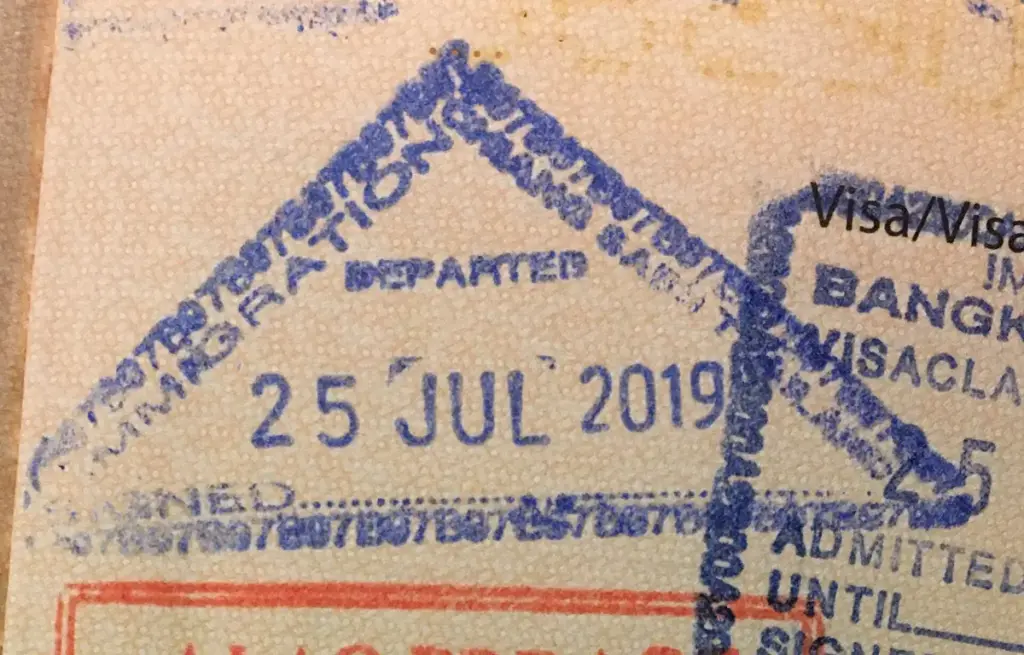
Under Section 39, the temporary stay permission ends when you leave. For someone on an extension, that means the remaining extension is gone. Then, on return, a visa-exempt traveller may get a fresh stamp if the passport still qualifies. Others may need a new visa, or may be refused entry. Guides say you cannot fix this after you have left, so plan ahead.
Therefore, check the permit step before you book a flight out. Also remember that the permit protects only the days left. If your visa expires while you are away, the permit lapses too.
Common mistakes to avoid
- Assuming it adds days. Instead, it only keeps the days you hold.
- Applying at the last minute. Allow time at the office or airport, and keep your receipt.
- Paying extra at a counter. Instead, check the fee and ask for a receipt.
- Forgetting the TM.30. Also, some offices ask for the address receipt, as our Thailand TM30 report guide explains.
Where to stay: continue south to Krabi
Once your paperwork is clear, a slow stay on the Andaman coast is a calm next leg. Our Thailand slow travel guide shows how to build one. From Krabi airport, Ao Luek is about 54 to 71 minutes by road, depending on traffic. In addition, our Krabi airport to Ao Luek guide covers the transfer.
At a glance: 17 houses from 1,200 to 2,000 baht per night, air conditioning in every house, free breakfast, free Wi-Fi and a swimming pool, at 97/1 Moo 1, Ao Luek Nuea, Krabi.
We recommend Ban Kamnan Resort in Ao Luek Nuea. For one or two guests, House #5 and #6 each have one 5 ft bed, one bathroom and 28 m². They cost 1,200 baht per night. Like every house, they have air conditioning. Also, guests share the swimming pool, and breakfast of toast, fried eggs and hot coffee is free. Prices match the resort's listing, so check your dates on Booking.com. Also, ask the front desk about the TM30 receipt if you plan to extend.
Frequently asked questions
Guides are not consistent for tourists. Some say visa-exempt visitors without an extension do not need one, because a new entry gets a new stamp if they qualify. Extension holders do need one if they want to keep the extension. Ask the Immigration Bureau about your case.
As of November 2026, the Bangkok Immigration Division fee page lists the re-entry permit fee at 1,000 baht for a single permit and 3,800 baht for a multiple permit.
A Royal Thai Embassy page says you may apply at the airport before leaving, and one legal guide lists counters at major airports. We found no source for a Krabi airport counter, so ask first.
No. It keeps the remaining days of the stay you already hold, and it lapses if that stay expires while you are abroad.
One legal guide says online applications are not possible. So, apply in person at an immigration office or an airport counter before you leave.
Final thoughts
A Thailand re-entry permit is a small form with a large effect if you hold an extension, so treat the Thailand re-entry permit as part of your exit plan. To sum up: apply before you leave and choose single or multiple by how often you travel. Then pay the official fee and keep your receipt. When you plan a slower stay, check availability at Ban Kamnan Resort on Booking.com and plan your Krabi base.
This is general information, not legal or visa advice. Rules, fees and counter practice change, and offices apply them differently. Confirm details with the Thai Immigration Bureau or your local immigration office. Sources: the Bangkok Immigration Division fee page, the Immigration Act B.E. 2522 (unofficial translation, Office of the Council of State), the Board of Investment one-stop service FAQ, the Royal Thai Embassy in Wellington, ThaiLawOnline, TAT.