

 Krit Ariyathiti
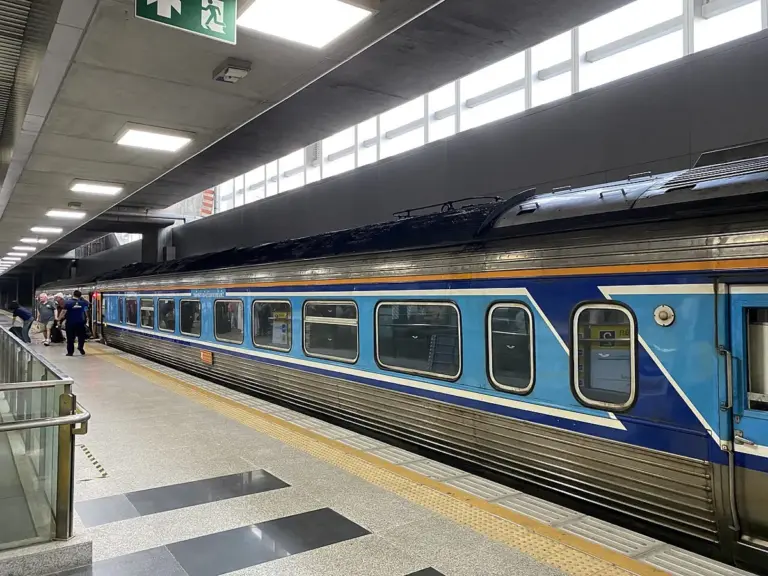
Train travel in Thailand is slow, cheap and full of character: you can fall asleep in Bangkok and wake up among the northern hills, or roll over a famous wartime bridge on a wooden-seat train. This guide explains the main routes, the Thai train classes, how the Thailand sleeper train works, how to book train tickets in Thailand and how to ride the Death Railway train to Kanchanaburi, plus how to reach Krabi by rail and road.
Quick answer: The State Railway of Thailand runs four main lines from Bangkok: north to Chiang Mai, north-east to Nong Khai and Ubon Ratchathani, south to Surat Thani and Hat Yai, and east towards Pattaya and the Cambodian border. Long-distance trains now leave from Krung Thep Aphiwat Central Terminal. As of November 2026, you can book most long-distance trains up to about 90 days ahead on the official D-Ticket website, with your passport details. The overnight sleeper to Chiang Mai takes about 11 to 14 hours, and a second-class lower berth costs roughly 1,000 baht, according to booking sites.
Why choose train travel in Thailand?
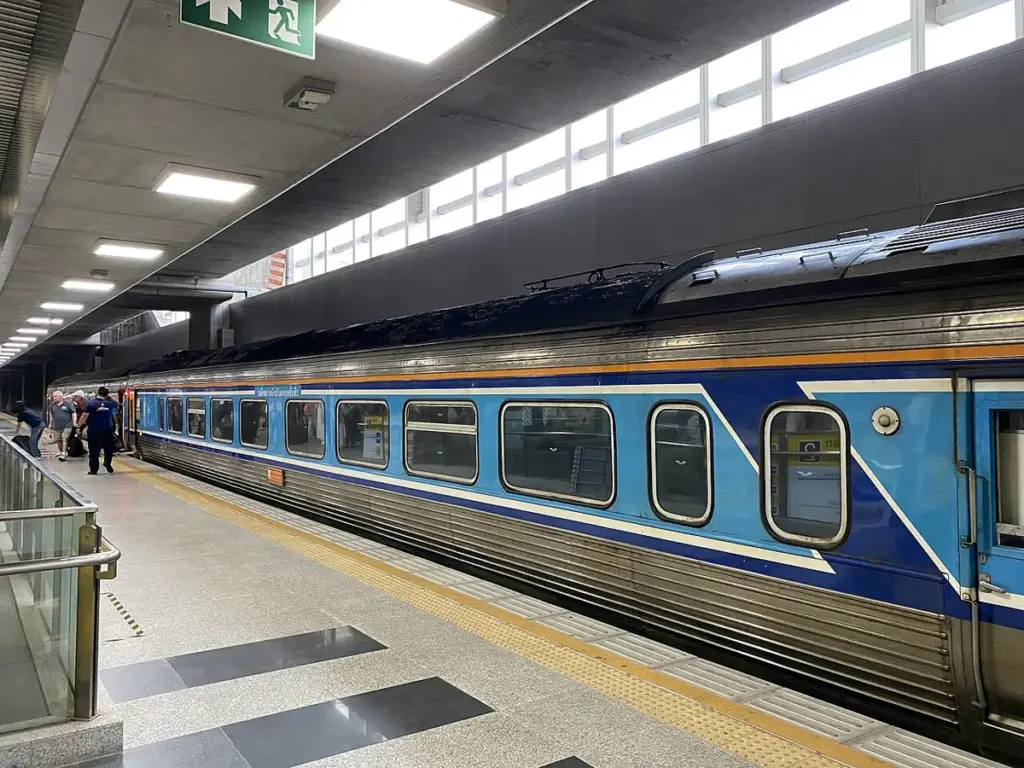
Train travel in Thailand is not the fastest way to cross the country. However, they have real advantages. First, an overnight sleeper saves a night's hotel and a day of travel. Second, the views of rice fields, jungle and mountains are a highlight in their own right. Finally, trains are safer and more comfortable than long night buses, according to many travellers.
On the other hand, delays are common, and some trains arrive an hour or more late. So, never plan a tight flight connection after a long train journey. Instead, treat the train as part of the holiday.
The main railway lines from Bangkok
Most train travel in Thailand starts in Bangkok, where four main lines and one branch line begin.
| Line | Main stops | Typical use for visitors |
|---|---|---|
| Northern | Ayutthaya, Phitsanulok, Lampang, Chiang Mai | Sleeper to Chiang Mai |
| Northeastern | Khon Kaen, Udon Thani, Nong Khai, Ubon Ratchathani | Isan and the Laos border |
| Southern | Hua Hin, Chumphon, Surat Thani, Hat Yai | Gulf islands, the south, connections to Krabi |
| Eastern | Chachoengsao, Pattaya, Aranyaprathet | Pattaya and the Cambodian border |
| Thonburi branch | Nakhon Pathom, Kanchanaburi, Nam Tok | The Death Railway |
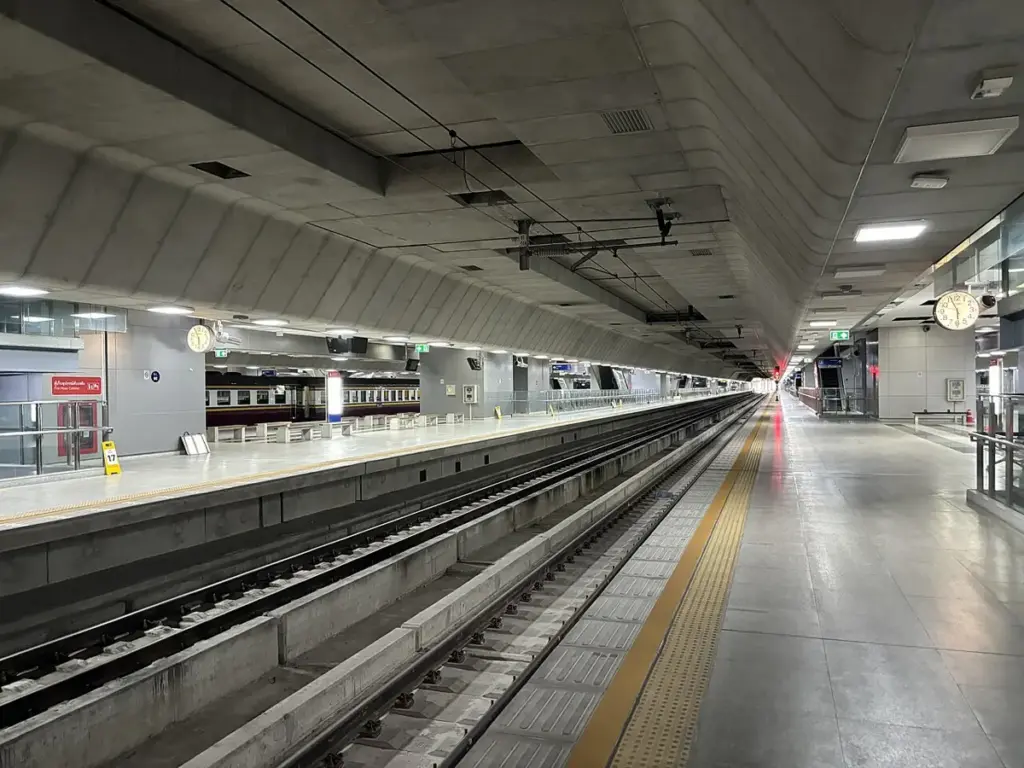
Long-distance trains on the main lines now use Krung Thep Aphiwat Central Terminal in the north of Bangkok, formerly called Bang Sue Grand Station. However, some ordinary and local trains still use the old Hua Lamphong station, and the Kanchanaburi trains leave from Thonburi station. Therefore, always check the station printed on your ticket.
Thai train classes explained
There are three main Thai train classes, and the choice makes a big difference on a long trip.
- First class. Private cabins with two berths, a door that locks and air conditioning. It is the most comfortable option, but it costs much more.
- Second class. Open carriages with seats that the attendant turns into upper and lower berths at night, each with a curtain. Most visitors choose this class. The lower berth is wider and has the window, so it costs a little more.
- Third class. Simple seats, often with fans and open windows. It is very cheap and great for short daytime trips, but hard work overnight.
In addition, train travel in Thailand involves four speed grades: Special Express, Express, Rapid and Ordinary. As a result, the same journey can take very different times, so compare trains before you book.
The Thailand sleeper train
The Thailand sleeper train is one of the country's classic journeys. The best-known route is Bangkok to Chiang Mai. According to 2026 guides, it takes about 11 to 14 hours, leaving in the early evening and arriving the next morning. Our Thailand itinerary 2 weeks uses it to link the capital and the north.
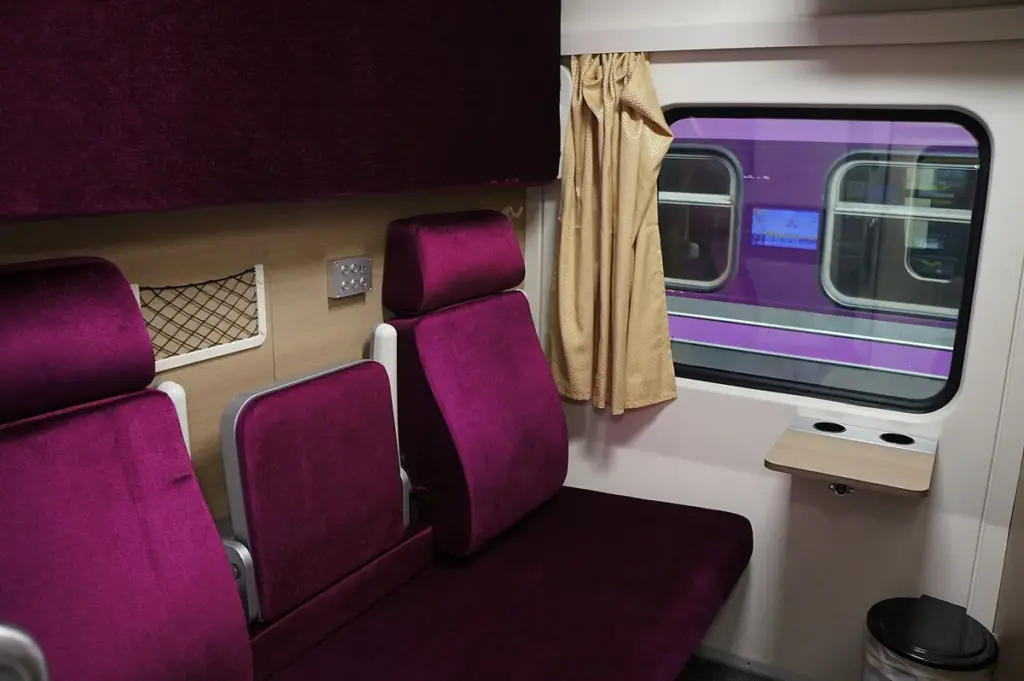
Booking sites list a second-class lower berth on Special Express No. 9 at roughly 1,000 to 1,050 baht and an upper berth at about 940 baht. Fares change, so check the official price when you book. Meanwhile, the southern sleeper to Surat Thani takes about 9 to 12 hours, with second-class air-conditioned berths listed at about 800 to 900 baht.
Tips for a good night:
- Choose a lower berth if you can, because it is wider and has a window.
- Bring a layer. Air-conditioned carriages can get cold.
- Pack snacks and water. There is usually a dining car or a trolley, but prices are higher.
- Keep valuables with you. Sleep with your phone and passport in a small bag inside the berth.
- Leave the beer for later. Drinking alcohol is banned on trains and at stations, under government orders reaffirmed in 2025 and 2026.
How to book train tickets in Thailand
Here is how to book train tickets in Thailand in four steps:
- Use the official site. The State Railway of Thailand sells tickets on its D-Ticket website, dticket.railway.co.th, in Thai and English. Foreigners register with a passport number.
- Book ahead. As of November 2026, long-distance tickets usually go on sale about 90 days before departure, according to recent news reports. Popular sleepers sell out early around holidays.
- Match your passport. The name on the ticket must match your passport, so type it carefully.
- Use a counter if needed. You can also buy tickets at major stations with your passport. Ordinary and local trains are usually sold only at the station.
Some travellers report problems with the website's verification codes and card payments. If that happens, reseller sites sell the same tickets with a booking fee. The SRT hotline is 1690.
The Death Railway train to Kanchanaburi
The Death Railway train follows the line built by prisoners of war and forced labourers during the Second World War. Today, two ordinary trains a day leave Bangkok's Thonburi station, at about 07:45 and 13:55, according to train guides. They reach Kanchanaburi in roughly two and three-quarter hours and then cross the Bridge over the River Kwai.
Foreigners pay a flat fare of 100 baht on this line, according to the same guides, and tickets cannot be booked online. So, arrive early and buy at the station. Most visitors ride as far as the bridge or the wooden viaduct further along, then return by train or minivan. Kanchanaburi also pairs well with Erawan National Park, famous for its turquoise waterfall pools.
Short and scenic train trips
- Bangkok to Ayutthaya. Frequent trains make this an easy day trip to the old capital, and third class is fine for the short ride.
- Bangkok to Pattaya. A slow daily train runs to the coast, as our Bangkok to Pattaya guide explains.
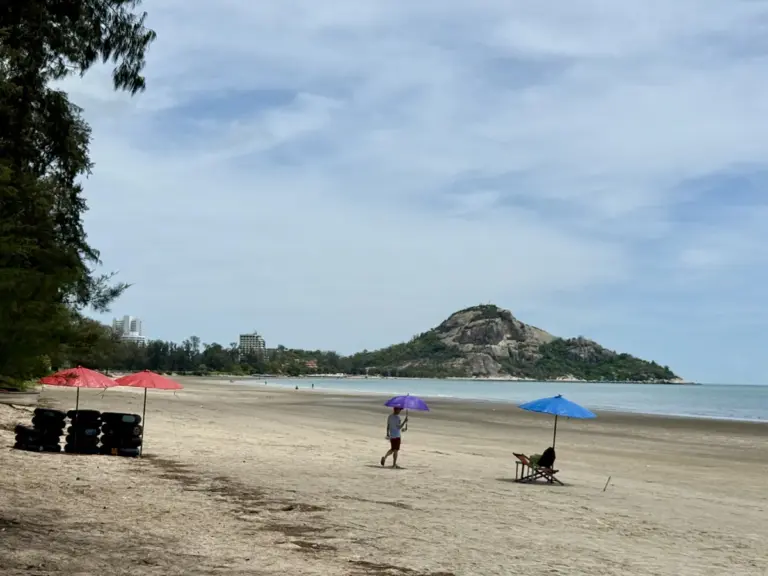
- Bangkok to Hua Hin. The southern line passes Hua Hin's historic station on the way south.
Can you take the train to Krabi?
No. Train travel in Thailand does not reach Krabi province, because there is no railway there. Instead, take the sleeper train to Surat Thani and then a bus or minivan for about 2 to 2.5 hours to Krabi. Our guide to Bangkok to Krabi compares the train, bus and flight options in detail. Alternatively, fly to Krabi and use Grab in Thailand or a rental car for the last leg.
Where to stay after the train journey south
After a long day of train travel in Thailand, a calm base helps. From Surat Thani, buses run to Krabi Town, and from there it is a short drive to Ao Luek. If you fly instead, Ao Luek is about 54 to 71 minutes by road from Krabi airport, depending on traffic. Our Ao Luek travel guide lists the springs, caves and mangroves nearby.
At a glance: 17 houses from 1,200 to 2,000 baht per night, air conditioning in every house, free breakfast, free Wi-Fi and a swimming pool, at 97/1 Moo 1, Ao Luek Nuea, Krabi.
We recommend Ban Kamnan Resort in Ao Luek Nuea. For couples, House #5 and #6 each have one 5 ft bed, one bathroom and 28 m², for 1,200 baht per night. Like every house, they have air conditioning. Also, guests share the swimming pool, and breakfast of toast, fried eggs and hot coffee is free. Prices match the resort's listing, so check your dates on Booking.com.
Frequently asked questions
Yes, in general. Trains are a common and safe way to travel. Still, keep your passport, phone and money with you, especially at night on a sleeper.
Book on the State Railway of Thailand's D-Ticket website with your passport details, or buy at a major station. As of November 2026, long-distance tickets usually go on sale about 90 days ahead.
About 11 to 14 hours on the overnight sleeper, according to 2026 guides. Most trains leave Krung Thep Aphiwat Central Terminal in the early evening.
Most long-distance trains leave from Krung Thep Aphiwat Central Terminal. However, some ordinary trains use Hua Lamphong, and Kanchanaburi trains leave from Thonburi station.
No. Take the train to Surat Thani, then a bus or minivan for about 2 to 2.5 hours to Krabi.
Final thoughts
Train travel in Thailand is a slow and memorable way to see the country. So, book a lower berth early, check your station and bring a layer for the cold carriage. Then let the scenery do the rest. For costs across your trip, read our guide to Thailand travel costs, and for the north see things to do in Chiang Mai.